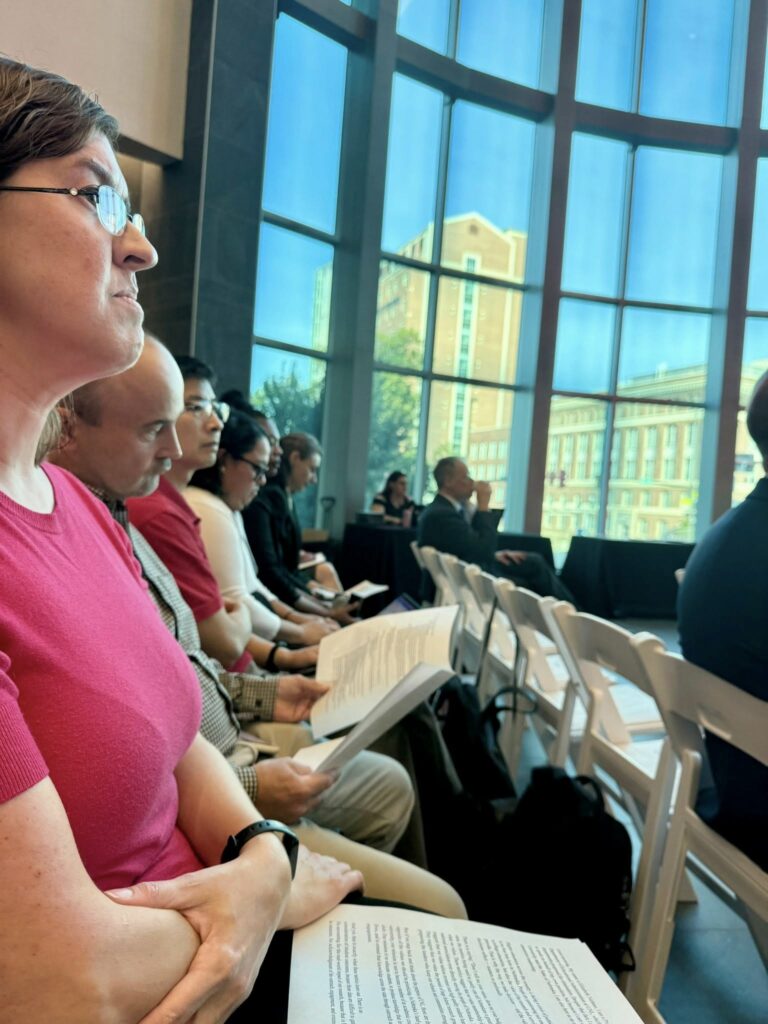
Beth Niehaus, UNL AAUP Chapter Member-at-Large, spoke at the NU Board of Regents meeting on Friday, October 3rd. She spoke about the importance of values to institutions of higher education and the distrust that follows when leaders overlook their duty to the larger mission of a university.
Good morning. My name is Elizabeth Niehaus. I am a Professor in the Department of Educational Administration at UNL, which is among the departments proposed for elimination. Despite that fact, I am here today not to speak on behalf of my own position, but because I care deeply about this University and the State of Nebraska. I am also here as an expert on higher education leadership.
Higher education across the country is facing a crisis of public trust, and that is no less true here in Nebraska. People are questioning not only the value of a college education, but also the value of the research and service universities provide. That is why the way we make decisions — and the values those decisions reflect — matters so profoundly.
There is a saying: “Don’t tell me your values, show me your budget.” In this case, the metrics being used to justify cuts tell Nebraskans a great deal about what we value. These metrics suggest that we value membership in an elite national association over directly serving the people of Nebraska. They suggest that we value tuition revenue over high-quality student learning. They suggest that we value the pursuit of large federal research grants over preparing the leaders who keep our schools and communities strong.
But if we step back and think about the purpose of UNL, those are the exact opposite of the values we should be prioritizing. As Nebraska’s land-grant university, our mission is not to become a member of an academic country club. Our mission is to educate students, to produce knowledge that improves lives, and to extend that knowledge across the state through outreach and engagement.
And yet, that is exactly what these metrics leave out. There is no consideration of student outcomes, because those data are difficult to gather. No accounting for the real-world impact of our research, because that is hard to measure. No acknowledgment of the outreach, engagement, and extension work that connects this university to Nebraskans across the state. As researchers often say: “Not everything that matters can be measured, and not everything that can be measured matters.” Right now, what is being measured does not reflect the true mission of this institution.
When leadership builds such consequential decisions on an incomplete and deeply flawed foundation, the process itself becomes suspect. That erodes trust — not only in these specific decisions, but in the University as a whole. And once lost, that trust will be very difficult to rebuild.
I urge you, as Regents, to consider what these choices signal to the people of Nebraska. If we continue down a path where hollow metrics outweigh real impact, we risk weakening the very institution that is meant to serve this state. The direction we are heading is not in the best interest of Nebraska, and Nebraskans deserve better.
Thank you.