
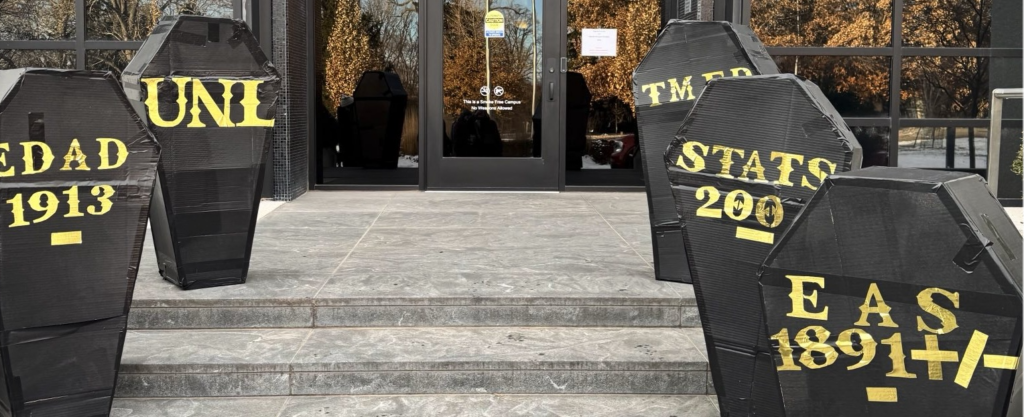
On Friday, December 5, over 110 faculty, staff, students, and alumni of the University of Nebraska filed into Varner Hall to testify against the elimination of four academic departments before the Board of Regents. While the packed overflow room had all the comforts of an overnight flight delay at O’Hare, I have to really hand it to Varner Hall about one thing: winter safety. A few days earlier, I had arrived at City Campus at 9:00 a.m., later than usual because of slick roads, to find this to be the state of the sidewalk leading from my faculty/staff parking lot to my classroom building:

In fact, a woman at the Board meeting on Friday testified that her daughter, a student, had recently slipped on an uncleared path on campus and shattered her wrist. That mother, like me, must have felt like a queen walking into Varner Hall on Friday. The steps and front walk were covered in electrified warming mats that melt the snow away and keep ice from ever forming. I guess when you get 56% of the system budget you can afford nice things like not falling.
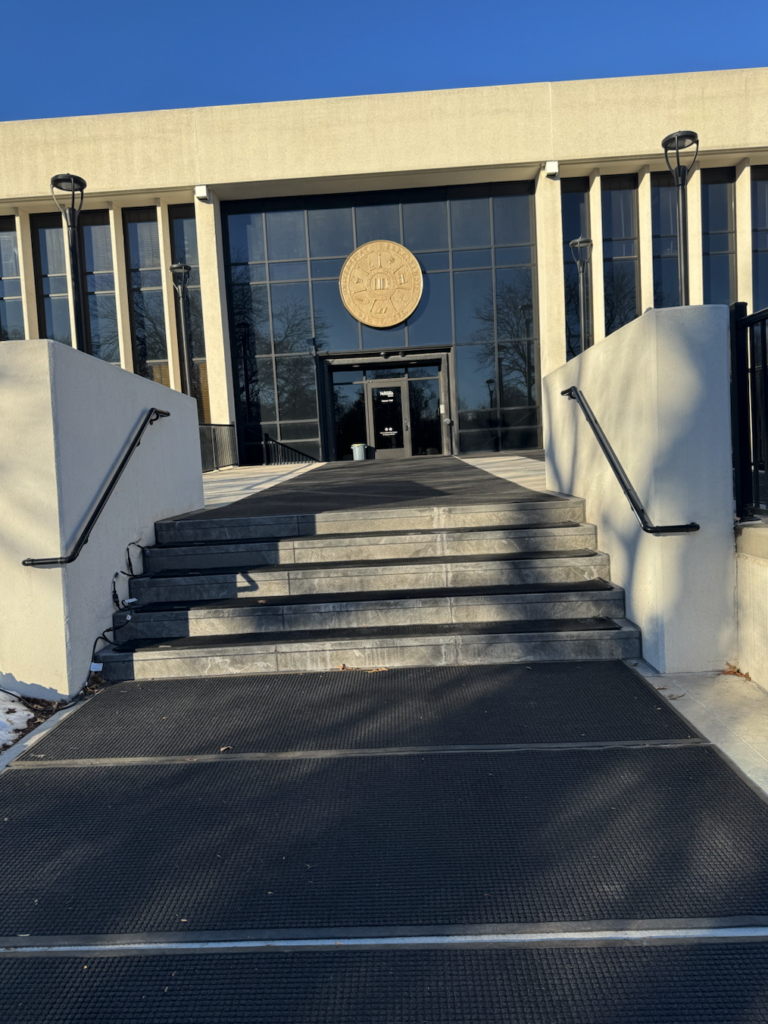
The five and a half hours of testimony, some of which was coordinated to offer fuller arguments than what a single three-minute time-slot would allow, covered a range of concerns and perspectives. Here were some of the main arguments:
The conditions necessitating program cuts have not been met.
According to the bylaws, cuts of tenured faculty are only permitted in cases of 1) financial exigency, or 2) bona fide program eliminations. It may be the case that we are in a financial emergency—the Regents certainly believe so—but to be in a state of financial exigency requires following a process, including its official declaration by the Board, and that has not happened. As for bona fide program cuts, the university undermined this argument by assuring some individual faculty members from the targeted departments that they would be kept on in other departments. That is, the university is picking and choosing individuals to keep, which belies the bona fide program cut argument. (It is also a real danger to academic freedom.)
The process for eliminating departments has not been followed.
When financial exigency or bona fide program cuts necessitate the elimination of departments, this is supposed to happen based on recommendations from the Academic Programming Committee (APC), not on post-hoc approval by the APC. What should happen is this: the APC regularly monitors departments; the administration regularly apprises the APC of the budget. At any given moment, then, the APC is aware of both the transparent, fully-documented budget situation, and how the various academic units are doing. When a budget crisis emerges, the APC can recommend adjustments—and cuts to departments should be the very last resort. It is the APC that recommends the changes, and the administration that approves and executes them.
That is not what has happened at UNL. The APC had not been fully apprised of the budget and the APC did not propose the solution. Instead, the administration presented to the APC a proposal to eliminate departments based on a metric of the administration’s own concocting; they then required that the APC rush its approval.
The metrics are not just a little flawed, but seriously flawed.
Over the past months, the affected departments—especially Statistics—have gone into great detail about how the metrics are meaningless. The problems are too abundant to recount here, but they have been extensively documented elsewhere, and range from basic factual errors to applying inappropriate measures and standards to the departments. These are all departments whose faculty have undergone annual reviews, as well as tenure and promotion reviews, and are now being found supposedly deficient by a demonstrably faulty algorithm someone pulled out of a hat.
The financial calculations appear to be so defective that it is quite possible, even likely, that these cuts will cost money. It appears that the revenue generated by these departments was not considered when calculating their cost—only the money out counted, not the money in. That is bad enough on its own to call the whole thing off, and it isn’t even beginning to account for indirect, long-term costs associated with alienating hundreds if not thousands of students, alumni, and faculty.
The administration has not been interested in hearing about this.
Bennett and other top administrators have not even shown up to hear the arguments from dozens of experts about why the evaluation is wrong.
The programs slated for elimination are valuable to the people of Nebraska.
Each of these departments is full of competent and committed faculty and inquisitive and ambitious students. What’s more, they offer opportunity to everyone in the state, including the chance to study foundational subjects like statistics and unique ones like textiles.
The Regents heard hour upon hour of testimony on these and other themes. And when they reconvened late in the afternoon after a closed-door session, they offered the students of Nebraska an invaluable lesson: It doesn’t matter. You can pack the halls like sardines, you can put on an hours-long masterclass in professional, reasoned, disciplined communication, and at the end of the day, those with power are going to do what they were always going to do.
It’s a lesson for our era, really.
Here’s a closer look at the reasoning offered by the Regents.
After dozens of professionals lined up to deliver hours of compelling argument—with receipts—about the broken process, the Regents handed the mic to Chancellor Bennett, and this was his rebuttal:
It is important for you to know that the process we followed is prescribed in UNL’s formal procedures to be invoked for significant budget reallocations and reductions, which was most recently revised and approved in 2022 by the University of Nebraska-Lincoln’s Faculty Senate, the Association of Students of the University of Nebraska, and the UNL Academic Planning Committee, which is a representative group of faculty, staff, students and university leaders. The executive leadership team and I worked hard to adhere to this comprehensive process, both in letter and in spirit, and to complete all steps within the provided timeline.
Based on input from members of the university community after previous rounds of budget reductions, it was critically important to us to avoid implementing a cross-the-board approach, which would have been detrimental to some of our most productive units and areas with growing enrollment. To this end, we utilized performance metrics for instruction and research that were shaped through extensive consultation in the spring with academic deans, college leadership teams, department executive officers, and the Academic Planning Committee. I’ll also note that Dr. Button made available any opportunity for any department who had concerns about the metrics to visit with him and to try to get that resolved.
[Guffaws from audience]
Contributions to mission—
[Gaveling and a call to order]
Contributions to mission, workforce needs of the state, and public service and extension were also considered. Each of the academic programs recommended for elimination fell below expectations.
The majority of Bennett’s remarks amount to nothing more than a “nuh-uh.” I mean, look at the entire first paragraph. Most of it is comprised of excessive spelling-out of the details of the policy document’s authorship, as though the authoritative sound of those details somehow prove that its process was followed. Most of the rest of his remarks continue to assert that admin did things the right way, but offer no specifics to counter the many alleged violations and anomalies—including allegations made by the very APC whose authority Bennett invokes.
So in the left corner: a procession of experts in statistics, science, and educational policy detailing flaws in almost every step of this thing. In the right corner: the chancellor saying no, for real, it was totes fine. Good enough for the Regents! Bennett wins!
The only substantive comment Bennett really made in all of this was that he decided they would rather chop off a few whole departments than cut across the university, as that would weaken the strongest departments. Okay, if we were imagining a scenario in which proper process was followed, that makes a lot of sense as a strategy: save the strengths, cut the weaknesses. And that is exactly the strategy not followed by NU System President Jeffrey Gold, who has been funneling ever-growing portions of the shrinking state funds to Varner Hall and UNMC while energetically exsanguinatingthe flagship campus.
Soon the regents spoke, explaining that they were going to vote to cut the programs. The tone taken by some of the regents as they addressed the faculty in the room was defensive, condescending, and scolding, at times conveying they were positively irritated that they were being made to feel icky for ignoring hours of reasons why they should not extinguish majors and cause dozens of professionals to sell their homes, uproot their families, and disrupt or even totally end their careers for the mistake of having believed that tenure, by-laws, and annual performance reviews meant something at the University of Nebraska.
The scolding reached its high point—or low point—when Regent Scheer, formerly the Speaker of the Nebraska State Legislature, addressed the faculty directly:
But I want to bring something into clarification. You all were talking about taking a pause, or just staying with with what we’ve got. But you know, I’m going to tell you, I will guess we have a hundred people in here, give or take—probably, maybe a little more.
The legislature funds the university. Over the last ten years, our dollars from the state have equaled to about a-hundred-and-some million-dollar loss a year, keeping up with inflation and others. That’s that’s not chump change. That’s a lot of money, especially when we’re talking about less than ten million dollars here.
A hundred million overly solves that problem.
Now my question to you: Of the hundred people here, how many of you went to the legislature when they were having a hearing on the university’s budget? OK… Less than ten, probably five. No, don’t shake your head! I’ll count on them. Over here there were very few hands, and there weren’t—there certainly wasn’t 20% of you for sure.
Of course, Scheer is absolutely correct that the legislature, with the backing of the previous and current governors, has defunded the university. Scheer was a state senator from 2012-2020, and it is the current university-defunding governor, Jim Pillen, who first appointed Scheer to the Board of Regents in 2023. I am not putting the defunding of the university at Scheer’s feet, but I am saying that nobody knows better than Scheer that the state government wants to defund public education, and nobody knows better than Scheer that a bunch of PhD-wielding nerds singing for their supper at the legislature would have an effect landing somewhere on a scale from absolute bupkis to sadistic titillation for the majority of senators there.
Perhaps I am cynical and jaded and Scheer is right to believe that it would be effective for a hundred faculty to show up at the legislature. If so, he should really let Bennett and Gold know. For years the administration has dissuaded faculty from testifying at the legislature on such matters. The First Amendment and university bylaws protect the right of faculty to engage in politics as private citizens. Nonetheless, it is periodically made clear that admin do not want us to do so. In 2019, for example, we were told we needed to register with the university in advance if we intended to testify on any bills at the legislature, including the bill numbers or general topics we would speak to. In 2022 this was ensconced in Executive Memorandum No. 2: “all campus personnel are expected to keep the Vice President for External Relations informed in an expedited manner of all contacts either in-person, oral, virtual, or written – with the executive or legislative branches of the federal or state government. This is not intended to restrict immediate response to inquiries from these governmental entities but rather to insure that appropriate persons are informed and involved.”
In January of 2024, the Associate Vice President for Government Relations issued a memorandum titled “Guidelines for Political Engagement by Employees of the University of Nebraska System,” which opens with this paragraph:
This document is to assist employees understand [sic] their rights and responsibilities under applicable policies when engaging in political discourse. Employees are required to coordinate any official advocacy efforts or policymaker engagements with their campus government relations officers to maintain clarity, consistency, and compliance with state and federal statutory reporting requirements, including the Federal Lobbying Disclosure Act and the Nebraska Political Accountability and Disclosure Act.
I don’t know what is meant by “political discourse,” “official advocacy efforts,” or “policymaker engagements” (except that that last phrase made Orwell awake from his grave, weep, and go back to dead), but it sure sounds like I might land in a world of state, federal, or workplace hurt if I commit a policymaker engagement wrong. The University acknowledges employees’ right to say words to the government, but they are also communicating to employees that we do so at the risk of pissing them off and running afoul of a range of legal and bureaucratic intricacies.
An extremely unscientific poll of faculty who responded to my texts today reveals a general opinion: We have the right to testify about the budget but the university thinks their lobbyist will handle it and the rest of us would probably fuck it up.
So between the administration implying that you might break multiple laws and piss off one of those guys who wears a suit every day and does not have to empty his own office trash can, and the general futility of beginning a sentence with “Hi, I want to talk about the importance of atmospheric science” when addressing people who coal-rolled up to the Unicam that morning, no, not too many of the former honor roll students comprising the faculty decided to put down their beakers and go stick it to the man at the appropriations hearing. But hey, maybe they should! I have done so myself! I think there are lots of reasons for us to be more present at the Unicameral. But please spare the faculty the fingerwagging for not defying the wishes of their employer and interfering in a process they have been led to believe they should avoid. Really, the implication that the faculty did something wrong by putting pressure on the regents rather than the legislature is ridiculous.
This was not the most ridiculous feature of the meeting, however. The Board offered a masterful lesson on what the CEO set presumably calls something like executive responsibility avoidance, though I would suggest the title Passing the Buck While Passing the Bucks.
Here is what emerged from their comments:
1. The Regents have seen this budget crisis unfolding for years—many years. The money coming in has been less than the money going out, and that is just a fact universally known among the regents. Regent Weitz has known about it for six years: “I think that we’ve known this was a debt for a long, I mean, I’ve been on the board six years and it was growing when I started my first term. And so I totally agree that we must address and we must stop borrowing from our rainy day fund or whatever you want to call that.” Gold says it has been happening for more than five years: “We have been burning through reserve dollars for the better part of the last decade. It just gets amplified every year.” Regent Clare has known about it for an undetermined amount of time: “I’ve been on this board for now 17 years and we have proverbially kicked the can down the road for a long, long time.” And so has Regent Scheer: “For the last 7-8 years, we’ve been going to the savings account and covering it and at some point that’s not going to work.”
2. The Regents set the budget and hire a president. To quote Regent Clare: “But at the end of the day, we have two key duties as Regents. One is to select the president. And we’ve done that. We’ve selected an amazing leader for our institution. And the second purpose, our second major purpose is to set the budget for the University of Nebraska.”
3. Gold was aware of the budget crisis from the get-go, and understood from about the time he was hired that he had to address it: “Well, the, the history really goes back to the fall of 2024 when or even the summer when shortly after I accepted the responsibility to be the president of your university and got a very clear message from the Board of Regents, from the governor, from members of the Legislature. But we needed to get our act together and balance the budget and eliminate the structural recurring deficits and quote, live within our means, unquote.”
Okay, so as of summer 2024 the financial situation had been terrible for many years and the regents had not solved it despite the fact that setting the budget is one of their two main duties. They then hired a new president—at literally double the pay the system president was making just seven years earlier. The regents and president, all as fully aware of the flagship’s looming financial crisis as anyone could be, then got together to establish the basis upon which Gold’s performance will be evaluated. Well, if we imagine a group of alarmed regents sitting down with the highest paid system president in state history, all of whom are watching the flagship campus careening toward a financial cliff, we can all safely guess what will be at the very top of the list of stuff those regents are going to make sure that president does, right? In fact, we wouldn’t be surprised if there’s only one thing on the list: making sure the flagship campus is shored up financially—through lobbying, fundraising, or allocation of state funds—and if all that fails, making sure that the process for paring down the campus is scrupulously followed.
But what if instead they come up with a list of priorities that makes no mention whatsoever averting catastrophe? Here are the metrics submitted in the summer of 2024:
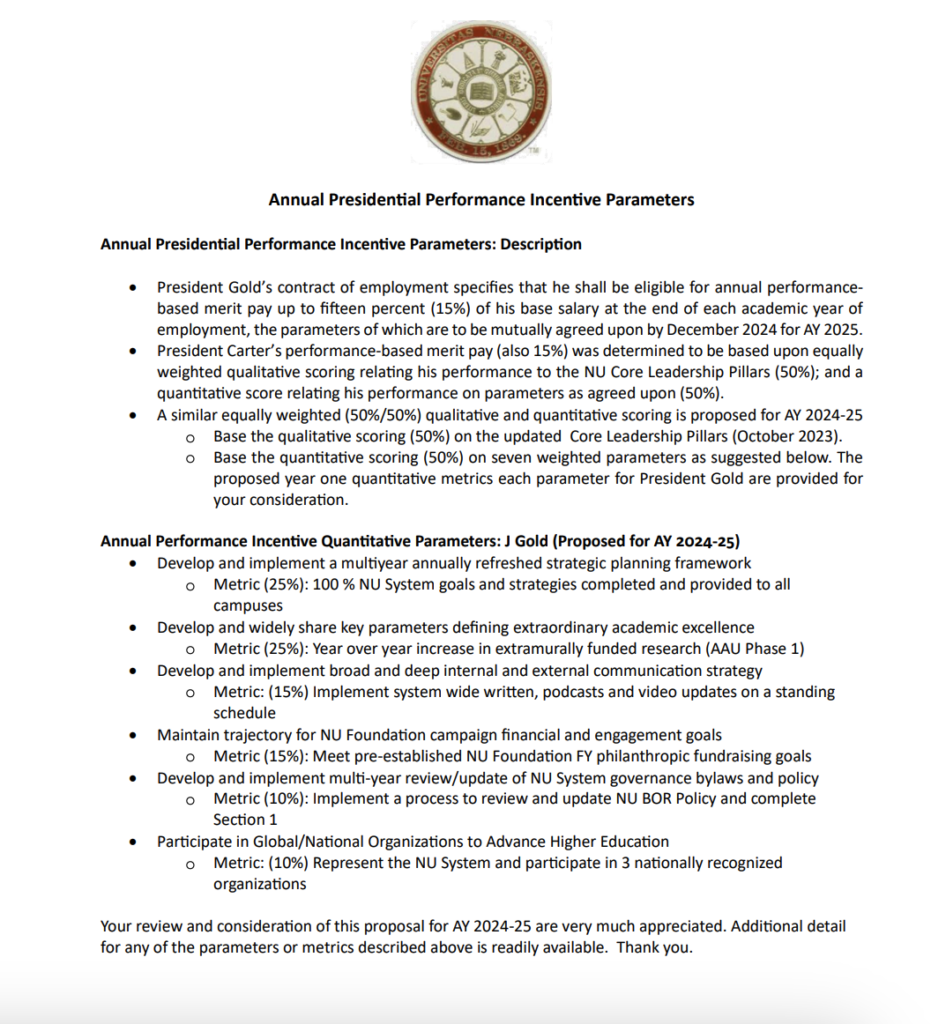
So half of Gold’s evaluation will be based on the “NU Core Leadership Pillars” and half will be based on other enumerated metrics. The Core Leadership Pillars are:
- Proven Leader
- Strategic Thinker
- Prioritizes Higher Education, Academic, and Research Excellence
- Committed to “One Nebraska”
- Political Acumen
- Capable of Fundraising
- Values Diversity and Inclusion
- Values University as a Global Leader
- Values Intercollegiate Athletics
I’m sorry, I know this is off-topic, but the grammatical non-parallelism of this list made me break out in hives. Also, is “values diversity and inclusion” still an NU Core Leadership Pillar even though it has forbidden words we had to take off all our web sites?
What is not off-topic is the fact that most of this list makes strange metrics. Some of the items are redundant, or features of other items. More importantly, some of the items aren’t about performance at all. “Capable of fundraising” isn’t the same as raising adequate funds. “Valuing the university as a global leader” is surely a pleasant experience, but it’s a mental state, not an outcome. Someone could go to our quilt museum and say, “isn’t it nice how the university is a global leader in textiles?” That person has just valued the university as a global leader, which is admittedly more than many of our state senators do, but hardly seems like it ought to comprise a metric, especially if she were to turn around and say “oh sure, go ahead and get rid of the textiles department.” And is the mental state of “valuing intercollegiate athletics” a list-worthy attribute of a system president or a condition spread through the state’s tap water?
But this is only half of how Gold is to be evaluated. The other half was to be based on the “seven weighted parameters” listed in the document, except the document only actually lists six weighted parameters.

I have read the six weighted parameters several times and don’t see “make sure the flagship doesn’t fall off a cliff” anywhere in there. I don’t see a word about making sure a catastrophe is either averted or its damage minimized, despite everyone involved in approving that document being excruciatingly aware of the problem. In fact, the only mention of money on the list asks that the president “maintain the trajectory” of “pre-established” fundraising goals. So a new president with a new salary faces a looming crisis, and “just keep steering that way” is the only apparent financial metric he must meet to earn a bonus that itself is higher than the salary of almost all of the 50 or so tenured faculty who just got chopped.
Yet by December 2025, this financial crisis was an official five-alarm fire and not! a! single! moment! could be wasted on such nonsense as making sure the cuts would actually save any money or checking to see if the people who brought you the seven but really six metrics for Gold’s performance may have erred in their evaluation.
Earlier this year, the Board determined that Gold had met all his objectives. This presumably included “valuing diversity and inclusion” even as Ethnic Studies was silently vaporized, ODI was dismantled, and every unit across campus had to delete “diversity” and “inclusion” from their web sites. The flagship was still barreling toward the edge of the canyon, but that was fine because saving academics at the flagship was never a metric! What could the Regents do, then, but approve Gold’s $159,000 bonus?
They wrung their hands. It was bad optics, giving a man a bonus that is four times what a full-time lecturer makes, on top of his million-dollar-plus base pay, when the Regents had just raised tuition and we were in a hiring and wage freeze. What to do, what to do? Their hand was forced. Regent O’Connor said, “This contract was voted on by the board and approved in the budget, and the university cannot enter into contracts, [and] refuse to honor them…”
No, indeed. It is a terrible thing when a professional is hired to do a job, meets or exceeds their objectives, then has the terms of their employment unilaterally broken. Just ask any of the faculty in Educational Administration, Statistics, Earth and Atmospheric Sciences, or Textiles, Merchandising, and Fashion Design.
