
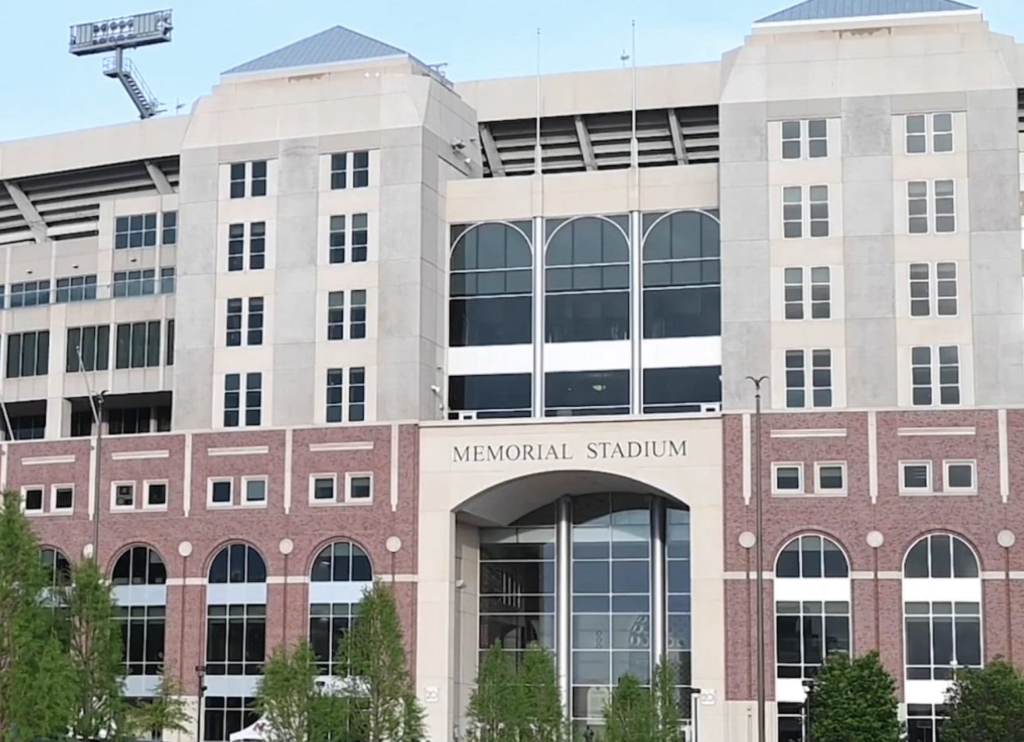
The Board of Regents approved a $600 million plan to renovate Memorial Stadium—called the Big Red Rebuild—at their April 24 meeting.
All eight elected regents voted in favor of the proposal. Three of the four student regents voted for it. Brock Calamari, the student regent from the University of Nebraska Medical Center, cast the only vote against it. The votes of the student regents have no official impact on board actions.
The $600 million estimated price tag for the renovations is 21.8 times the $25.7 million the regents cut earlier this year from the UNL academic budget. Those cuts resulted in the closure of four departments and the dismissal of dozens of faculty members.
President Jeffrey Gold in his remarks earlier in the meeting and a couple of the regents during the discussion of the proposal emphasized that the stadium project would be paid for with private donations, not with tax or tuition money.
The regents initially approved a program of improvements to the stadium in 2023 when Trev Alberts was athletic director. The current athletic director, Troy Dannen, asked for time to review and revise the original plan. The regents already had approved spending of up to $48.5 million on design services. The measure approved April 24 gives overall approval to the $600 million project, including immediate spending of $175 million to purchase steel, certain electrical equipment, seating elements and sitework equipment and carrying out some demolition work.
The regents who spoke to the proposal emphasized the need for improving the stadium’s infrastructure and making it compliant with standards of the Americans with Disabilities Act.
Regent Jim Scheer of Norfolk said while previous improvements to the stadium made it look better, there were elements of the structure’s electrical and plumbing systems that were out of date. “There’s probably $200 million worth of renovations that no one’s ever going to see or understand, but they (are) needed to be done just for the facility to be actually used,” he said.
Scheer also said the improvements will make it easier for fans, particularly elderly ones, in South Stadium to get from their seats to facilities and back. “If you have to go to the bathroom (from the upper rows of South Stadium), you might want to wear Depends,” Scheer said, “because you would be going up and down and it would take about six hours to facilitate that.” The changes to address ADA issues will make it easier for fans to reach their seats, he said.
Robert Schafer, the regent from Beatrice, recalled the collapse of a portion of the East Stadium balcony 25 or 30 years ago. “And if that would have happened on a home football Saturday with the packed stadium, I can’t imagine how many people would have potentially lost their lives,” he said.
Regent Barbara Weitz of Omaha said the improvements were a matter of fan safety. She worried that if some emergency arose, fans could be injured trying to evacuate the stadium. “I think it’s part of the whole redo to build a stadium where people will feel like they can get in safely and they can get out safely if they need to evacuate,” she said.
Calamari, the student regent who opposed the measure, said it represented a break from Nebraska tradition. All previous changes to the stadium had expanded it, allowing it to accommodate more fans. After 2010 additions to East Stadium, seating capacity was more than 90,000. The Big Red Rebuild, he said, means the stadium’s capacity will be sharply reduced to about 80,000. “This project will be an inflection point,” he said. “For the first time, we are substantially reducing capacity. We’re also boosting revenues at the same time by 40 percent to cover the debt financing.”
Although the current project focuses on the south and west parts of the stadium, Calamari said it was inevitable that similar changes would be made to the north and east parts. With fewer seats available at higher prices, the nature of the fan base will change. “(The) focus is shifting from being accessible to the most fans possible to maximizing the revenue per fan,” he said.
Calamari said he agreed the stadium needed upgrades to its infrastructure and to improve accessibility, but those changes should be separated from the rest of the proposal. He made a motion that effect, but it died for lack of a second.
In another action, the regents approved changes to their bylaws and policies. The main change to the board’s policies was to clarify when the university would indemnify board members and other university personnel for monetary judgments against them for actions they take in their official duties. The change says the university will not be obligated to indemnify them if the actions arise from “malfeasance in office or willful and wanton neglect of duty.”
The policy changes were to sections on the rights and responsibilities of professional staff, the rights and responsibilities of students, and business and financial management. Most of the changes were to update language to match current usage. One substantive change, however, appears in the section on academic responsibility (RP 4.1.1) and affects language regarding respect for fellow faculty, students and staff. The old language reads:
Each member of the community should be treated with respect and dignity. Each has the right to learn. This right imposes a duty not to infringe upon the rights of others. The academic community should assure its members those opportunities, protections, and privileges which provide the best climate for learning.
That has been replaced by the new language saying:
Each member of the University of Nebraska’s community (students, faculty, and staff) should be treated with respect and dignity. Each has the right to learn. Faculty have the primary responsibility for assessing a student’s academic performance. Faculty, staff, and students, limited by their roles and responsibilities, have the right to contribute to the evaluation of academic community members, courses, and academic programs. These rights impose a duty not to infringe upon the rights and responsibilities of others. The academic community should assure its members that these opportunities, protections, and privileges provide the best climate for learning, research, creative activity, and outreach.
Earlier in the meeting, two UNL faculty members addressed the regents during the public comment period. Erin Haacker, an associate professor in Earth and Atmospheric Sciences, one of the departments eliminated in this year’s budget cuts, described the chaos the cuts have left behind.
The department chair has taken early retirement, she said, and no one knows who will assume those duties. Nor is there any plan about how to close the department. “None of the phase-out is actually part of anyone’s job,” she said, “which is incredibly frustrating for the people left to clean up the mess.”
The EAS department had a rate of 95 percent for placing graduates in their field of study, Haacker said. Now students don’t know who will be teaching key classes, and freshman meteorology majors have no alternative atmospheric science programs in the state, she said.
It remains unclear how much money the university will save with the cuts, she said, “but if the goal was to create chaos, confusion and distress—mission accomplished.”
Regina Werum, a sociology professor, said the regents—including the ones who take office after the fall elections—need to understand that public education is not a business, it is a common good.
“Understand that a public university requires sustained public support to deliver a 10-to-one return on investment,” she said. “Understand that we’re not just a land grant but a comprehensive university, and UNL’s impact is unique. Understand that higher education is not about training people for an ever-changing job market. Our role is to reduce barriers to social mobility.”
In other business, the Board of Regents:
- Approved the elimination of four degree programs at the University of Nebraska at Kearney. Neal Schnoor, the new chancellor at UNK, said the eliminations were part of the $4.5 million in cuts the university had to make. The UNK cuts, he said, were proportional to those made by UNL. The programs eliminated were the bachelor’s in modern languages with a German emphasis, the bachelor’s in teaching German in middle and high schools, the master’s in higher education student affairs, and the bachelor’s in music with a music business emphasis.
- Approved the creation of a bachelor’s program in professional training and development and a doctor of social work program at the University of Nebraska at Omaha. They also approved transitioning a program in either elementary or secondary special education to a K through 12 special education degree in order to comply with new state Department of Education standards.
- Approved the establishment of the Research Center for Developmental Toxicology and Pharmacology at the Medical Center in Omaha.
