
Apparently some people and some interactions don’t matter.
If you’re reading The Bugeater, you likely already know that on December 5 the NU Board of Regents voted to eliminate four academic departments at UNL: Earth and Atmospheric Sciences, Educational Administration, Statistics, and Textiles, Merchandising, and Fashion Design. What you may not know is that the trauma of the past three months did not end with the vote. In many ways, the vote was only the beginning.
Throughout this process, faculty and staff were repeatedly told that the university would treat people with respect and humanity. That promise has now been broken and the consequences are severe.
Termination Notices
On December 12, roughly 75 faculty and staff received an email signed by Mark Button, Tiffany Heng-Moss, and Anne Barnes outlining “next steps.” Inside was the revelation that, come early January, every affected faculty member will receive a formal “notice of separation” giving them 12 months notice, as required by Regents’ bylaws.
Twelve months sounds generous on paper. Anyone who knows the faculty job cycle, however, knows that 12 months starting in January is not actually 12 months.
A quick note for those who don’t regularly engage with the academic job cycle: the academic job market essentially runs once a year. Postings begin in the fall. Applications are due late fall or early spring. Campus visits happen soon after. New hires start in August. New jobs usually mean uprooting your entire life to move across the country to a different college or university.
So if you get notice in January 2026? You’ve already missed the 2025–26 cycle. Which means your next real chance to apply is fall of 2026… for jobs beginning August 2027. If your UNL employment ends in January 2027, that means six to eight months of unemployment for people with families, mortgages, and careers built here. And of course that is assuming you get a new job during that first cycle. Often it takes multiple cycles to secure a new job that is a good fit.
Promises, Promises
Both Button and Heng-Moss assured the Faculty Senate (and Button assured Graduate Council as well) that they would respect the academic year cycle and termination notices would not be issued until late spring. Those assurances mattered and people planned around that timeline. Even a four-month shift from May to January effectively determines whether faculty have any chance of a smooth transition or whether they face unemployment and instability.
Yet someone at the system level is insisting these notices go out in January. Who? No idea. Why? No explanation.
And the most infuriating part is that it doesn’t have to be this way. There is no financial exigency. There is no crisis. This is a choice.
Keeping all of the faculty and staff in these departments employed one more semester would cost less than $3.5 million. To put that in perspective for those of us whose salary is less than the million dollar salary that President Gold gets annually, that’s about 1% of the university’s unrestricted assets or roughly half a percent of NU’s state appropriation for 2025. In other words, pocket change. (Perhaps the kind found in Varner Hall’s couch cushions?)
The money exists. The capacity exists. What’s missing is the willingness to treat people humanely.
A New Layer of Exploitation
As if early termination notices weren’t enough, faculty were informed this week that those needed for teach-out may not receive true extensions of their current appointments. Instead, they may be offered temporary lecturer roles, with no clarity about salary, benefits, or full-time status.
Think about what that means: people who have built programs, advised students, mentored graduate researchers, and dedicated their careers to this institution may be forced to accept downgraded positions just to keep their families afloat for one more year. Many would love to tell administrators exactly what they think of these degrading offers. But people have bills. Kids in school. Lives rooted here.
This is not respect. This is not humanity. This is exploitation.
What This Means for Everyone Else
If you are not in one of the eliminated departments, you should still be paying close attention. Here is what we are all learning from this:
- You cannot trust leadership’s assurances. Even when they believe them, they can be overruled by… well, we don’t even know.
- You cannot trust long-standing academic norms or university policies to protect you.
- The Chancellor and the Regents have made it clear that this is not the end of the cuts.
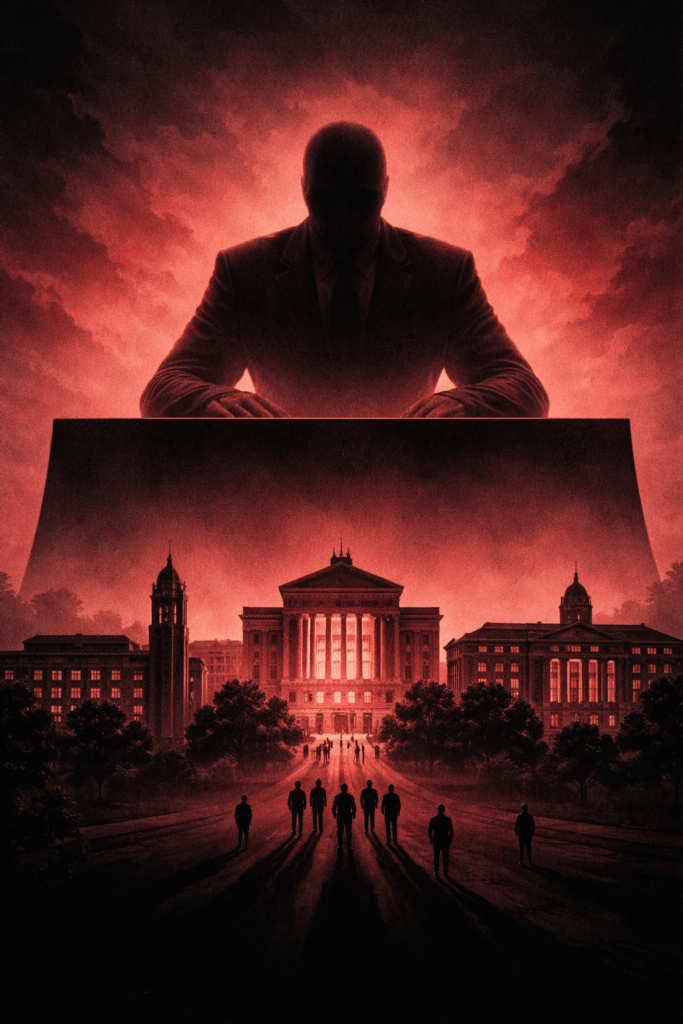
At this moment, it is not even clear who is making decisions. Jeff Gold? The Board of Regents? Someone behind the curtain? No one seems to know.
But we do know that those with power had the option to treat people with dignity. They chose cruelty and exploitation instead.
What will We Choose?
Faculty and staff are being harmed unnecessarily, not by budget numbers, not by external constraints, but by the decisions of our own “leaders.” These choices were avoidable. They still are.
The question now is not just what leadership is choosing. It’s what we will choose in response.
Will we turn away, keeping our heads down in the hopes that we won’t be next? Or will we stand with our colleagues, name what is happening, and refuse to accept cruelty as the new normal?
Cruelty is a choice. So is solidarity.
