
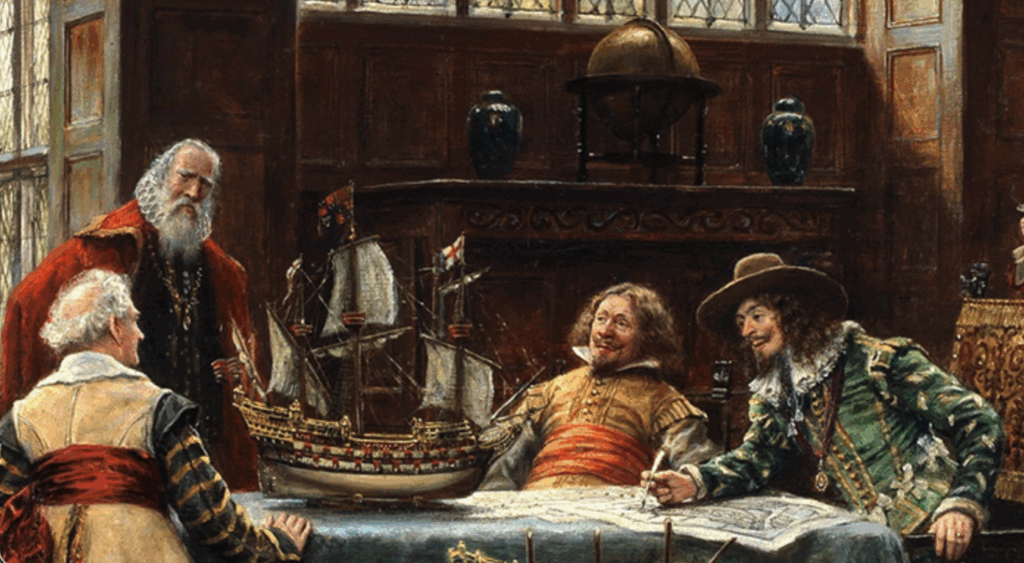
“This is a model, right?”
“No, that’s her, gentlemen. The new flagship. Why? Don’t you like her, Reginald?”
“Well, it’s just.. it’s a bit small, innit?”
“That’s the genius of it, Reginald–smaller means cheaper!”
“But… how are we supposed to sail this on our extraordinary odyssey?
“What do you mean, Francis? The metrics say she’ll fit right on that map, easy.”
On Tuesday, November 4, UNL Faculty Senate President John Shrader commenced the senate meeting–attended by faculty both in person and via Zoom–by sharing his grave concerns about the future of the university. If you haven’t read his remarks, you should. Chancellor Bennett was next to address the senate, and some attendees wondered if he would respond to Shrader or the larger matter of the motions to schedule an emergency no-confidence vote on his leadership that the Senate would be discussing that day.
For most of his business-as-usual remarks the chancellor did not address the no-confidence question, and instead issued a fairly ordinary account of administrative matters. Given that 1) the chancellor has proposed cutting multiple academic departments based on metrics that have been debunked by professional statisticians, 2) the Academic Planning Committee wrote an excoriating report about the administration’s handling of budget cuts, and 3) the Senate was about to deliberate whether to schedule the no-confidence vote, it was particularly strange that neither the content of the Chancellor’s remarks nor the affect in which they were delivered reflected the turducken of crises before him. He had been provided the text of the no-confidence measure that the body would deliberate that day, yet total confidence seemed to be the theme of the business-as-usual remarks.
It was not until the Q and A that the chancellor’s veneer began to wear thin. He explained that he could not tell the group the number of faculty who would be lost to the voluntary separation program, because he himself had not been informed of the number. When pressed, he answered that Varner Hall had declined to share with him, the chancellor of the flagship campus, the number of faculty who had been enticed to retire. One might expect a chancellor under such circumstances to find this intolerable and to muster the faculty–who know neither how many of their colleagues will disappear nor how much this enticement will relieve the financial crisis–with “We ride at dawn!” But this chancellor didn’t bring it up until asked, and responded only reluctantly that it was not in his control.
During an exchange about the budget cuts, the Chancellor, again choosing his words carefully to avoid conveying information, indicated that much about the cuts had not been up to him. When asked whom, then, it had been up to, a lengthy pause ensued, during which some in attendance began wondering if the Chancellor might need to be turned off and turned back on again. Finally he replied that it was the process. The buck apparently does not stop with the chancellor, nor any man, but rather the vagaries of process. (“As soon as certain topics are raised,” wrote Orwell, “the concrete melts into the abstract.”)
As the Q&A concluded, the Chancellor let on that he was aware of the Senate’s agenda, and advised the body to consider how much worse the cuts would have been if the university had not had such a stalwart advocate as him fighting for it.
But fighting against whom? Policy, the antagonist of a moment ago? Or was it the state legislature, whose appropriations, despite being meagre, have been enough to increase investment in UNMC and Varner Hall? Or prior administrators, who had made bad bets that the long foretold “demographic cliff” was going to miraculously turn out to be a demographic launch ramp? Or the NU President, who has been diverting blood from the core of the campus system to its extremities? Guessing is all we can do when we have nothing but baffling self-inflicted injuries to go off of. Why does the leader of a campus insist on fast-tracking indefensible top-down cuts to academic programs rather than simply explaining exactly what or who is forcing his hand?
To some faculty, one of the cruelest ironies of the cuts is that they have been decreed by administrators who command salaries that are completely out of whack with those they are un-employing. These are administrators who benefit from the golden revolving door of the higher-ed CEO class, who often flit from one job to the next, with each campus advised by highly paid consultants to always be increasing top admin salaries to attract the best and brightest. If your campus doesn’t want some uninspired follower at the helm, you had better always be increasing admin salaries so that you can ensure you get a visionary leader, one who will have the courage to… well, jettison a bunch of crew members just in case the ship springs a leak later.
The golden revolving door of the higher-ed CEO circuit doesn’t just drive up base pay to levels that ought to embarrass anyone claiming to be a public servant–much less a public servant laying off dozens of core public servants. The golden revolving door also justifies offering extra incentives to top execs who commit to what counts as the long haul at whatever lily pad they have just alighted upon. Universities now offer “deferred compensation” to administrators who really stick it out and put down roots at their new homes–these administrators can’t cash out the deferred compensations until three whole years–or at least two–have been spent on the job. Imagine the agony of this delayed gratification, being forced to collect a high-six or seven-figure salary for perhaps a thousand days while the extra money just sits around doing nothing but growing.
The NU president and UNL chancellor receive such compensation packages:
NU President Gold
Time in current role: under two years
Base salary: $1,062,573
Bonus for reaching performance goals, in the midst of a raise freeze and an alleged financial crisis: $159,000. (Gold declined this bonus after negative publicity.) Note that Gold’s contract stipulates that he and the Board will negotiate what these goals are after he is hired, and that they will find them “mutually agreeable.” Contrast this with the changing junk metrics imposed unilaterally upon faculty to justify their termination, even though the faculty had been meeting the established expectations of their departments and colleges.
Deferred compensation: $106,436 upon contract start in July 2024 (based on previous salary in former role), then approximately $50,915 in February 2025 (prorated for 5 months in office), $122,196 on June 30, 2026, and so on at 11.5% of base salary every year. The payout schedule blocks most of the money until two years in office.
UNL Chancellor Bennett
Time in office: less than three years
Base salary: $720,000
Deferred compensation: 11.5% of base salary (about $82,800) vested every July 1, starting in 2023; the approximately $414,000 invested thus far (not including interest) is not accessible unless Bennett stays on the job until July 1, 2026.
Another notable compensation: According to the contract, the university (presumably using Foundation funds) will pay the costs associated with joining a country club of his choice. Country clubs make a point of not publicizing their fees, because only gauche plebes would wonder about cost, so the gauche plebe writing this piece had to consult Reddit, where a country club aficionado named “lbest32” (pronounced, I can only assume, Le Best Trente-Deux) claims:
Wilderness ridge is $3500 initial and $355 monthly plus $240 every six months for food.
The country club last I knew was like $10-15k initial and $300-400 monthly plus food monthly. but you have to have another member sponsor you.
Is Le Best Trente-Deux an authoritative source on Lincoln country club costs? No. Do we need to track the actual amount down to make the point that a chancellor who is being paid over $700k, plus (barely) deferred compensation, plus country club scrip is making baffling decisions to boot faculty teaching stuff like meteorology and statistics to Nebraska students? Also no.
Add up the annual base salaries ($1,782,573), Gold’s bonus ($159,000), and the deferred compensation for a year (204,996) and you get $2,146,569. The annual compensation packages of these two men is considerably higher than the annual cost of any department they have slated to slash, some of which have well over a dozen faculty going to work every day to serve the core missions of teaching and research. In fact, their two compensation packages total about 1/3 of the cost of all the departments they want to cut, which include the salaries of *52* full-time employees. Where–where, I say!–can the NU system look for the less than 1/10th of 1% of the system budget these academic programs comprise? They have looked under every couch cushion; they have combed the lawn of Varner Hall with a metal detector; and–oh hang on, they are just rolling down the window real quick to ask Le Best Trente-Deux if he has any Grey Poupon–okay, yes, sadly, there is nowhere else to find that 0.01% than to sell someone’s kidney.
Anyway, this is all background to the Faculty Senate meeting, where, before our digression, Bennett had beseeched the senators to imagine what fresh hell might have befallen the campus had he not been in place to limit the damage to slashing a mere handful of academic departments full of tenured faculty whom he had adjudicated subpar using janky metrics. (To clarify, by subpar I mean that the administration had deemed them worse than okay. This is not to be confused with “below par,” which means the opposite to the country club set.)
The Chancellor then left the room through the fire doors at the back, and the Senate meeting proceeded with committee reports that everyone dutifully delivered and pretended to listen to while wanting to hurry up and get to the spicy stuff. Spicy is a relative term, and so when discussion of the no-confidence motions began, it mainly involved figuring out the many motions and votes required, continually consulting the one guy who has become keeper of the mysteries of parliamentary order, and coordinating the raising and lowering of real and Zoom hands.
Eventually the group reached some stage of deliberation where people could actually talk about the motion, and around that time, quite unexpectedly, there came a very loud and rapid banging on the fire doors at the back of the room. I was sitting in the second-to-last row, and the banging was alarming. My first thought was that someone was very angry about something and wanted to come into the room, and who on earth would be angry about the reports on commencement marshals or the Committee on Committees, and the only person I could imagine being angry right now would be the Chancellor, and obviously it’s not the Chancellor banging on the–oh, yep, it was the Chancellor.
A journalism professor in the back row made the frankly dubious decision to open the door to whomever was angrily pounding on it, revealing the Chancellor, who then, in stark contrast to the loud and alarming banging, spoke quietly to the journalism professor. Everyone in the room was wondering what in tarnation was going on, so the journalism professor relayed the message by yelling down the length of the room that it was the chancellor and that he wanted to speak to John Shrader right away–immediately after this meeting! Um…okay? was more or less Shrader’s perplexed response, and the journalism professor added “He wants to see you in his office!”
That part was supposed to be a joke–like, “you are being summoned to the principal’s office, you naughty Faculty Senate President, you!”–but it created some confusion because the folks at the other end of the room thought the Chancellor was literally summoning the Faculty Senate President to his office. The journalism professor at some point yelled that he was just joking about the office, and this led to more confusion, because some people, at least on Zoom, thought that the whole thing had been some kind of a joke. Oh, okay, that makes sense, the Chancellor did not actually just bang on the door of the meeting about whether he has the confidence of the faculty in order to interrupt and make a weird demand of the Senate President, and so the world operates as I know it to operate and we can return to business. But in fact the Chancellor had, indeed, done just that.
“What is going on? Is the Chancellor out there listening with a glass pressed against the door?” I asked my friend, and then all that talk of glasses suddenly made me want to go out those doors for a drink of water. As I opened the doors the Chancellor had just been banging on, he was right there, and it appeared to me he was stepping back from a leaning-in-ish posture before he began (or resumed) pacing, then left down the stairs. As I approached the doors to return to the meeting, it occurred to me that perhaps the doors locked automatically, and I would also have to knock on them to get back in, and wouldn’t that be just the kind of dumbass thing I would do? But no, they were unlocked and so I had no more need to bang on them than the Chancellor did.
If the Chancellor’s outburst had been an average person’s awkward and unbecoming moment, it would be unfair to recount it here. But this was an unusual moment in the middle of another unusual moment–the no-confidence discussion–which itself resulted from the unusual occasion of university leaders appearing to sabotage their own flagship campus. It seemed to me that the campus leader who has eschewed transparency while cutting other people’s jobs and educational prospects now wanted badly to listen in. The leader who thinks program cuts should be ruthlessly implemented with minimal advance warning or consultation with faculty became discombobulated when it was his own performance suddenly under attack. The chancellor who is subjecting departments to a bizarre Procrustean bed of metrics and who has no real interest in their objections now wants the faculty to reconsider their assessment of his leadership based on, well, he won’t say.
None of this inspires confidence.
