
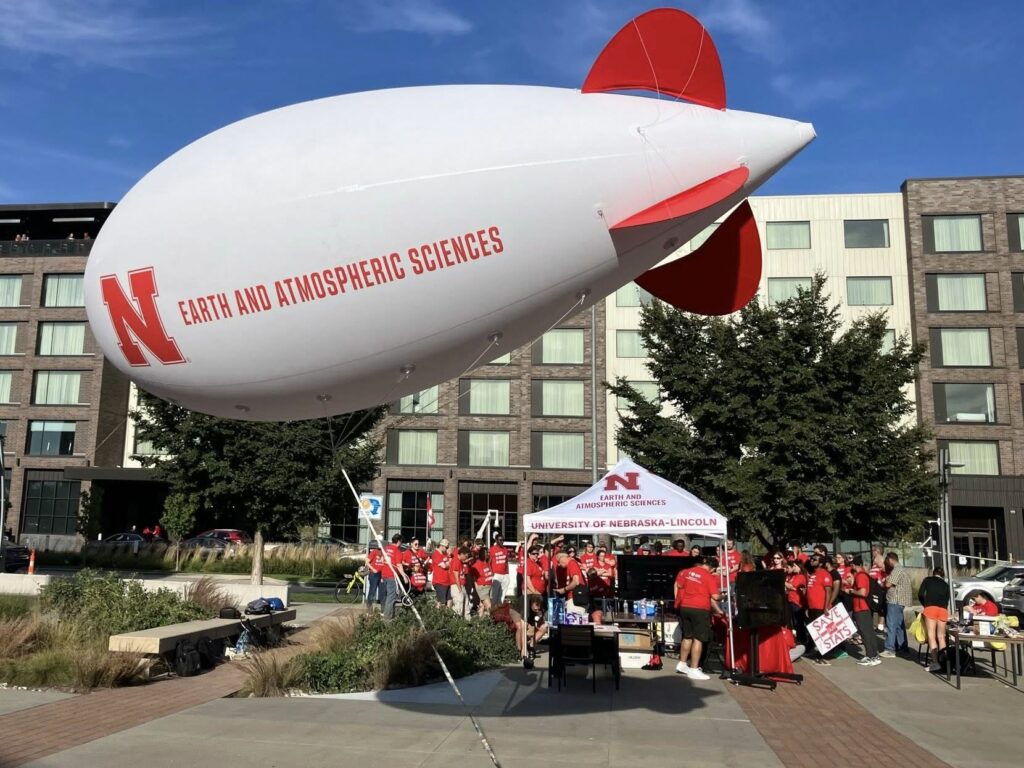
This guest post, written by Clint Rowe, Chair of the Department of Earth and Atmospheric Sciences Department, explains what is occurring within his Department with respect to faculty retentions and eliminations, ultimately highlighting the fragile state of tenure protections at UNL. We intend to share more realities unfolding in the Spring 2026 semester and aftermath of the December 2025 Board of Regents vote on departmental eliminations and budget cuts.
At the beginning of the 2025-2026 academic year, the Department of Earth and Atmospheric Sciences (EAS) consisted of the following 20 faculty:
- 13 tenured or tenure-track faculty with majority appointments in EAS,
- 6 full professors
- 5 associate professors
- 2 assistant professors
- 2 tenured full professors with minority appointments in EAS,
- 1 Associate Professor of Practice (PoP),
- 1 Assistant Research Professor (0.25 FTE),
- 1 long-term lecturer (0.50 FTE), and
- 2 teaching postdoctoral associates.
Prior to the announcement of the planned elimination of EAS, 6 of the faculty (including the PoP and one with a minority appointment in EAS) were contacted to schedule a meeting with the Dean of the College of Arts & Sciences (CAS) and the Executive Vice Chancellor (EVC). At those meetings, these faculty were informed that they would be retained in a different unit following the elimination of EAS. Presumably, the other full professor with a minority appointment has reached a satisfactory agreement for future employment with his tenure-home department. Following the vote of the Board of Regents (BoR) to eliminate EAS, one additional full professor was extended an offer of retention to ensure their spouse (tenured in another CAS unit) did not leave UNL. Three faculty chose to take the VSIP offer (1 full and 2 associate professors). The long-term lecturer and postdocs were assured their existing contracts would be honored. This left only 5 faculty (1 full, 3 associate, and 1 assistant) whose positions would be terminated upon the elimination of EAS (the “savings” from 3 faculty VSIPs have to be applied to the VSIP pool, as they cannot be counted twice). This is far short of the budget savings claimed by UNL administrators (12-13 positions, depending on the iteration of the rationale put forward). Retaining EAS as a unit somewhere in UNL could have been accomplished through ordinary attrition to account for those 5 faculty lines, especially as all 5 will be retained for one more academic year and 2 have received oral offers of an additional year of employment for the required “teach-out” plan.
Elimination is not for poor performance
As outlined above, elimination of EAS cannot be for budgetary reasons, even more so if revenue had been considered as part of the administration’s accounting. Nearly half of the faculty were retained, presumably indicative of past – and expected continued – good performance. The 5 terminated faculty were each told in their termination letters that “I [Interim UNL Chancellor Ankerson] want to emphasize that this decision is not a reflection of your performance. You have made significant contributions to the University, and we are truly grateful.” This means that the EAS faculty were not under-performing individually and, thus, it is impossible to understand how the department as a whole could be considered as under-performing to such a degree that it had to be eliminated.
How, then, can tenured faculty be terminated?
University bylaws (BoR Bylaws 4.4.3) states that “A “Continuous Appointment” is an appointment terminable only for adequate cause, bona fide discontinuance of a program or department, retirement for age or disability, or extraordinary circumstances because of financial exigencies.” This is reiterated in BoR Bylaws 4.12. According to BoR Policies (RP-4.2.11) regarding financial exigency, “Factors other than a financial crisis, including the desire to reorganize a major administrative unit or one or more of its sub-units, or the desire to implement long-range changes in educational policy, shall not be used to justify the declaration of a state of financial exigency.” Financial exigency been not been declared by the BoR. However, it seems logical and reasonable that restrictions on the termination of faculty established for cases of financial exigency should be followed under less dire emergencies such as a “structural budget deficit.” In section 2c of RP-4.2.11, following a declaration of financial exigency (again, not the case here), “The President and the Board of Regents shall thereafter consider and implement such cost-reduction measures, short of removal of faculty, which they deem feasible and appropriate [emphasis added].” That is, faculty termination should be avoided even in the case of a declared financial exigency.
Adequate cause has not been claimed with regard to any faculty member of EAS, leaving only “bona fide discontinuance of a program or department” as a means for terminating tenured faculty of EAS. This, therefore, raises the question of whether the processes and procedures followed by UNL and NU administration were indeed “bona fide” – a term used repeatedly but never defined in BoR or UNL bylaws.
Where, then, does this end?
It is impossible for UNL and NU to claim a commitment to tenure when tenured, untenured, and non-tenure-track faculty were retained and tenured and untenured faculty terminated in the same action. UNL’s actions with regard to EAS could rather easily be extended to a situation where the administration desired to rid itself of a particular (productive, tenured) faculty member who has become a “thorn in its side” by speaking out against administrative actions or policies. Avoid having to show adequate cause by simply declaring the discontinuance of the department while moving all other of its faculty to another unit, so that only the “difficult” faculty is affected. This would clearly be an end-run around the tenure system, but is no different than what UNL did in this case. All UNL (and, in fact, all NU) faculty should be concerned about this violation of tenure rights at UNL and should stand up to the administration to ensure those rights.
