
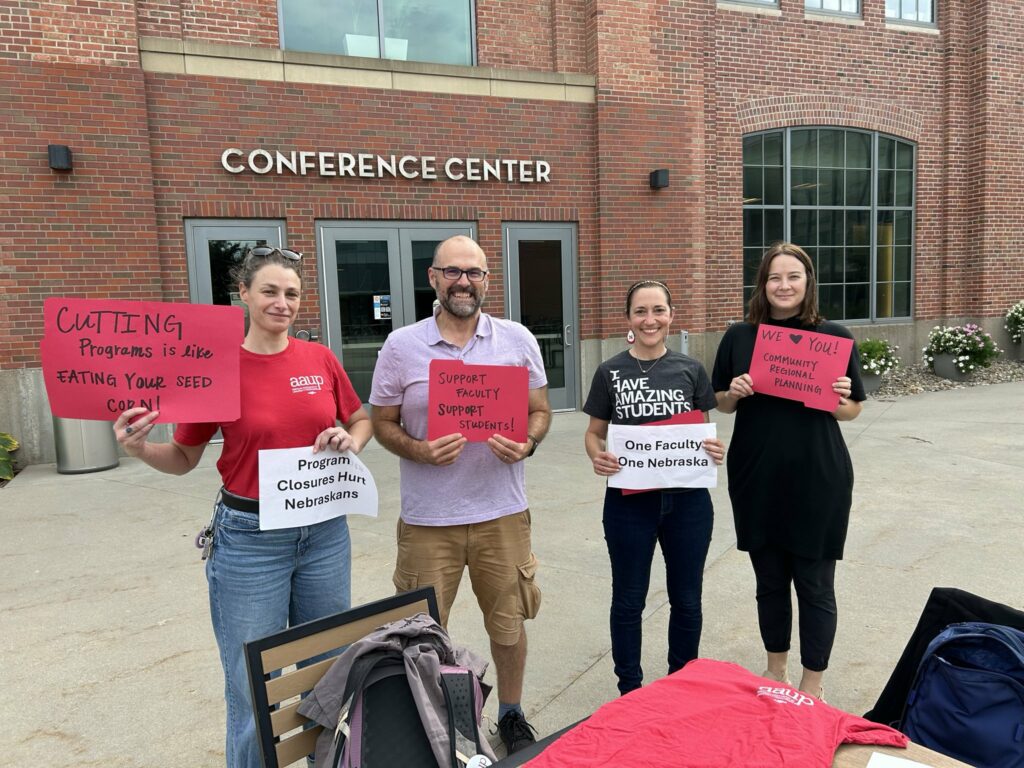
The pending $27.5 million in budget cuts dominated Chancellor Rodney Bennett’s remarks and faculty comments at the Oct. 7 UNL Faculty Senate meeting. Pervading many of the faculty remarks was a sense of frustration and fatalism about the process.
The cuts proposed by Bennett would eliminate six programs, merge four others and dismiss nearly 60 faculty members. Bennett said the proposals are now in the hands of the Academic Planning Committee. For that reason, he said he wanted to keep his remarks at a general level. “It’s important to maintain integrity to not impact that process,” he said. “It’s super hard work that they are involved in.”
Bennett said he recognized the impact the program eliminations will have on faculty members, their families and UNL’s academic program. “I appreciate the situation. I wish we were not here,” he said, noting the current round of cuts mean the university will have cut its budget by more than $100 million in less than five years.
The vertical cuts—ones that eliminate entire programs—were necessary, Bennett said, because many in the university community told him horizontal cuts—ones affecting all programs equally—were not sustainable. “I heard from community that we could not take horizontal cuts,” he said, “that we had to be more strategic to avoid harming the whole university.”
Corey Rumann, an assistant professor of practice in the education administration department, told Bennett the budget-cutting process did not feel like the product of shared governance. He said his department had requested data used in making the recommendation to eliminate it but had received neither the data nor a response. How can the department defend itself in a hearing before the APC when it is denied the necessary information? he asked. Other faculty members raised the same issue.
Bennett said the administration was adhering to the documents governing the reduction process: One is Procedures to Be Invoked for Significant Budget Reallocations and Reductions and the other is Academic Program Review Guidelines. Those documents say the process of developing budget-cut proposals should not be done in public, he said, and information should not be shared more broadly than the documents require.
“I know some are saying they don’t like the process,” Bennett said, “but then you (the faculty) have opportunity to change it. We’re operating in accordance with the documents.”
Before he ended his remarks, Bennett said another financial hit was looming. UNL is facing a substantial increase in insurance premiums, which will take effect Jan. 1, 2026. He said the campus will be informed on what the impact will be. The biggest increase, he said, probably will come in premiums for drug coverage.
Senate President John Shrader said he had planned to deliver remarks critical of the budget-cutting process at the Oct. 3 meeting of the Board of Regents. Because 17 UNL faculty members were planning to speak, he decided to turn the remarks into a letter to the regents, which he read to the Faculty Senate.
Shrader said the process, which was overly hasty, would inflict damage on the university that might be irreparable.
“These programs (slated for elimination) are long standing on our campus,” he wrote, “with scores of graduates working in this state and beyond; programs with decades, maybe centuries of faculty and staff experience put into them. We will lose dozens of faculty and staff members and quite possibly hundreds of students.”
Shrader said an analysis of the state spending on NU system campuses shows that the growth in UNL’s share is miniscule in comparison to what has been spent on other components.
“According to public records,” he said, “the state appropriated funds for UNL in the fiscal year 2017-18 was just under $471 million and the state appropriated funds for the fiscal year 2025-26 are just under $474 million. That is an increase of 0.6%.
“UNMC funds were increased by 28% during that time, UNO up 15% and UNK up 15%. The Central Administration funds were increased 106%.”
This chart shows the numbers underlying Shrader’s summary:

“NCTA” is the Nebraska College of Technical Agriculture in Curtis.
The effect of the way state funds have been distributed is a 24 percent decrease for UNL over the last eight years after adjusting for inflation, Shrader said.
Adding an additional $27.5 million cut on top of that is “not a formula for a return to the AAU (American Association of Universities),” he said.
Much of the discussion focused on the work of the Academic Planning Committee and the recommendations it will make to the chancellor. A couple of speakers said it seemed inadequate for programs facing elimination to have only 15 minutes to make their presentations to the APC. Ann Tschetter, Senate secretary and a member of the APC, said the schedule was forced by the number of budget reductions the committee will have to review. Unlimited written comments are welcome, however, she said.
Karen Griffin, faculty governance coordinator, said 2,253 comments had already been received and they were continuing to pour in. She said two faculty members were using artificial intelligence to analyze the comments and identify themes and major concerns.
Tschetter also said she thought the APC was getting enough information to make good decisions about its recommendations for the chancellor. Deans and department chairs were providing a good deal of information, she said.
Some faculty were concerned about how much effect the APC recommendations will have on the chancellor and the regents, neither of whom is required to accept them.
Bennett said he was open to recommendations from the APC and anyone else who can offer a plan for meeting the required cuts. He urged those affected by the cuts to take their opportunity to address the APC seriously and make the best arguments they can.
“We’ve already accepted many recommendations from the APC,” he said. “Their final recommendations are due Oct. 24. I will consider them carefully and will make any adjustments needed.”
In other business, the Senate received two motions. One is from the Executive Committee and would amend the Senate’s syllabus policy to include a sentence on whether students are allowed to use artificial intelligence in the class. The other, submitted by Susan VanderPlas, associate professor of statistics, would thank the APC members for their work on the budget cuts. Neither motion prompted any discussion or opposition, and both will be voted on at the November meeting.
