Last Friday, I cried my way through another Ed.D. dissertation presentation. Fifty-something 5th-grade students in Central Nebraska are now reading chapter books paired with non-fiction science and social studies texts. Teachers reported that students now want to read. The principal, my advisee, observed students so engaged in reading that they didn’t notice her walk in during a classroom visit. Previously, she told me about how students stop her in the hall to talk about the books they are reading and the projects they are doing.
Assessment scores show growth, especially in non-fiction text, an important area in today’s college and career learning standards. While the average science score hasn’t changed from the year before, the number of students scoring at or above the proficiency cut score has increased significantly, likely due to the integration of reading and science instruction.
Survey data demonstrated that many students grew in their motivation to read, especially to read challenging books, after only one semester.
Multiple data points suggest that thematic units in upper elementary are a curricular change worth continuing to pursue and improve upon. My advisee is going to be sharing her study results with the district reading curriculum committee, along with the research she read along the way, so that the other elementary students in her district can benefit from what she learned about how the joy of reading and achievement are not mutually exclusive.
To Change the World
This is just one example of how the UNLE EDAD Ed.D. brings to life the motto on the CPED sticker that adorns my laptop: “A Ph.D. is to study the world; an Ed.D. is to change it.”
In another school in Central Nebraska, 100 elementary students now attend school more regularly, with a reduction in chronic absenteeism from 39% to 11% in a year. In a small district in Eastern Nebraska, students at risk of dropping out of high school are now receiving individualized support that gives them a voice to ensure they complete high school, a major predictor of future life success. In Northeast Nebraska, another school leader is tackling a similar challenge by creating opportunities for high school students to condense their school day and spend their afternoons getting meaningful work experience. Allowing students to combine their schooling with work, and to have a voice in their education has helped them see a path to graduation and their future. This student is also creating advisories so that every student will have a caring adult and a sense of community, something often taken for granted in rural schools in ways that allow kids to slip through the cracks.
All of these projects address priorities in the state, from reducing chronic absenteeism to improving reading achievement to workforce development. Sure, they didn’t solve the whole state’s problems overnight, but each of these school leaders has made measurable improvements in their school that contribute to these overarching things our state leaders have said we need. And these students can do so because of the coursework and the advising in the UNL EDAD Ed.D. program.
It worked!
As one of my colleagues said to me recently, it worked! Yes, it did. The revisions to our Ed.D. program that launched in 2022 worked. Our students are doing meaningful projects in their settings. And they are finishing at higher rates and in a shorter amount of time than in the past. Being able to consistently graduate 75-90% of your Ed.D. students in less than four years is an accomplishment, given that nationally only 50% of Ed.D. students finish their degrees. At UNL, the average time to a degree was a lot longer than four years, with some hanging out forever.
The revision of the Ed.D. program that I led, as a pre-tenure faculty member, was based on research on graduate education, and specifically Ed.D. programs. I applied the research on cohorts to our design, the emerging research that suggests embedding dissertation work in courses reduces time to degree, and the scholarship going back to Lee Shulman in the 1990s, that having a signature pedagogy, a common approach to teaching and learning, is necessary for practitioner preparation.
The Land Grant Mission
As I write this, I think maybe it is important for our state leaders, and others, to know that higher ed is not just where the egg heads go to make their heads bigger. It isn’t just elitists in ivory towers and deep thinkers thinking thoughts alone in a room.
The mission of a land-grant institution, like UNL, is “to promote the liberal and practical education of the industrial classes in the several pursuits and professions in life.” Many of us at UNL take that mission seriously, and we provide practical education for individuals to pursue professions. That land grant mission is what brought me to UNL a decade ago. To be of service, to prepare practitioners to go out and make our schools better places for kids and teachers.
Back to the EDAD Ed.D. program…Sure, EDAD no longer pumps out dozens of Ed.D. students a year, as they did back when the program could be best described as a diploma mill. We also no longer have the rate of non-completion and the lengthy time to degree for some students. The problem with the diploma mill model is that you have to accept so many more students to spray and pray enough to finish. With a rigorous, scaffolded, intentional program, you don’t have to admit 30 students for 15 to graduate; you only have to admit 15. To be fair, we’re still not at 100%, but 75% after only one full cohort is pretty impressive.
I have lost track of the number of conversations over the last decade in EDAD about whether we want to be like other programs and dumb things down, or whether we want to be the program where the commissioners of education get their degree (as the last four have done, but who is counting). Every time we land, we want to be rigorous, but relevant, as the educational administration program at the R1 flagship university in the state of Nebraska. We have always been recognized as the land grant institution; we have an obligation to serve the state, and one of the ways we can do that is through the leadership of our students who can go on to improve the schools, colleges, and universities where they work.
Rigor and Relevance
That isn’t just vibes. There is research that suggests that school leaders who attended a leadership preparation program at an R1, flagship campus, had better outcomes related to the qualifications of their teachers. Why does that matter? Well, because teachers remain the number one factor in school-level contributions to student outcomes. Principals come in second. And while their work is often considered indirect (and hence, not fundable by the agency formerly known as IES), it is powerful because it is spread across a whole school building, not just impacting a single group of children. School and district leaders get the conditions right for teachers to do their best work, for students and families to feel connected to school, all of which supports better outcomes. So yes, that R1 rigor is important.
But so is relevance. As a Ph.D. student, I saw in my classmates, who were, by and large, teachers, principals, and higher education staff and administrators, struggling with the research methods courses. I knew then that what was happening in that program was not meeting their needs as practitioners, as leaders of educators. In 2014, a friend and I were asked to be part of the program review and to lead the collection and analysis of student data. We did surveys and focus groups with our classmates. When we looked at all of the data, we concluded that there was a need for an Ed.D. program. I did not know then that moment would come to define who I am as a professor and that a seed had been planted that would be watered by CPED over the next decade.
Your Program is Underperforming. Here is Another Award for It.
When I received my teaching award in CEHS last week, I had to listen to a chair of another department read a passage of a nominating letter about my teaching in the Ed.D. program, how I thoughtfully designed the core courses, and taught them with attention to detail and perseverance to get everyone over the bar. I got up, shook people’s hands, collected my little slab of glass with a big N on it, and sat back down. I assume I kind of blacked out trying not to cry. My friend told me that I looked stricken. Somehow, stricken is a word I associate with grief, how you might feel upon hearing of the unexpected death of a loved one. Accurate.
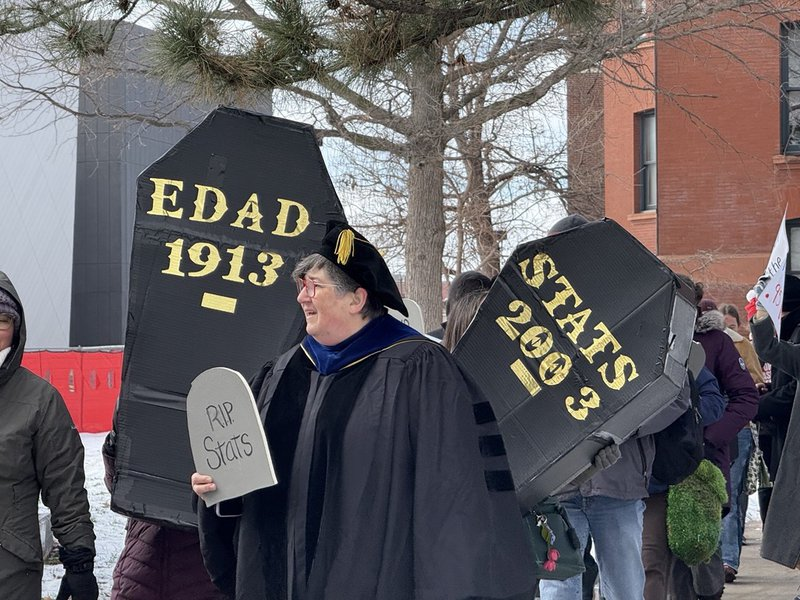
And while I mourn the murder of the EDAD Ed.D. program just as it began producing qualitatively and quantitatively better results, I also reflect on how short sighted it is not just reputationally (UNL will be the only Big10 university without an educational administration/leadership department) but also for the state as a whole since now that R1 rigor has been lost (let’s not mention how many faculty in the other EDAD programs have degrees from UNL).
Had anyone actually collected any qualitative data, instead of apparently just running on vibes of whoever Mark Button ran into in the hallway, I could have sat down and walked an administrator through all the things that go into differentiating the EDAD Ed.D. from the others in the state. From our improvement science courses to our dissertation in practice, what we do is, well, it’s qualitatively different from every other program in the state. By design. I could have walked them through the research and professional knowledge used to create what I hoped in time, through iterative improvement, would become an award-winning Ed.D. program.
Faculty are not Widgets
National AAUP has asked EVC Button and President Gold to save EDAD faculty members’ jobs (along with faculty in the three other units). On an individual level, that is important. Everyone has bills to pay. But without reinstating the department and putting the whole band back together, the true impact of the EDAD cannot be recreated. The same is true for TMFD, EAS, and STATS. Yes, all those folks need jobs, but placing faculty in different departments doesn’t fully remedy the harm done to the university and the state at large. Because at the end of the day, we aren’t just interchangeable widgets. The sum of an academic program is more than its component pieces. And the sum of a university is more than its component departments. And the sum of a public, land-grant university is so much more than a citation count. It is in the stories captured by the EDAD Ed.D. dissertations in practice of how individuals apply their learning to create a better world, and how they capture what they’ve learned in the process for others.
In our meeting with President Gold over spring break, he was asked if he wanted to rebuild trust; why not take the easy win and reinstate all four departments and start the process over with true shared governance and input from faculty? No can do, he said. He also said in that meeting that the savings from cutting faculty will be used to provide remaining faculty with raises. There were no fewer than three faculty from cut programs on that call. But I digress…
A University is Not a Med School with a Football Team
Our leaders don’t care about the land-grant mission of the university or the impact the university has on the state.
If a budget is a statement of value, this year’s nearly billion-dollar buyout of Clarkson Medicine, on top of the $2.4 billion new med center, and the over half a billion-dollar stadium renovation, speaks volumes about the priorities of our leadership: to be a university hospital system with a semi-professional football team. And you can say, well, that is all donor money, but damn, how many professorships could you endow with upward of $4 billion?
That money surely could have kept EDAD and the other four departments afloat for a very long time, so that each could continue to contribute to service to the state in ways that can both be quantified easily, and those that cannot, because they are like butterfly wings creating a ripple effect across the state…. 100 more kids going to school, 50 more kids acing the science test, and learning to love reading. That is what is lost for every student who will never have the chance to complete the EDAD Ed.D. program at UNL.
I’ll be at graduation on Friday for a group hug and a picture with most of the 2022 Ed.D. cohort. I’ll probably cry again. And I’ll definitely cry in August when my advisee, who helped students love to read, walks across the stage.