
More information: Regents by District | Regent District Map of the State | Regent Districts in Douglas County | Regent Districts in Sarpy County | Regent Districts in Lancaster County
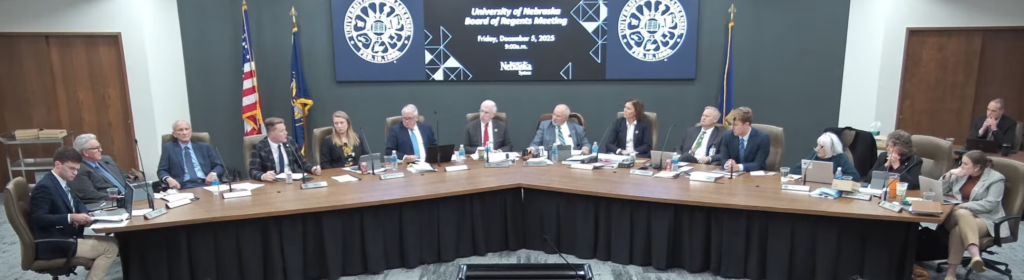
After the drama over UNL program eliminations at the December Board of Regents meeting, the Feb. 6 meeting was low-key and what drama there was came at the very end.
The last matter the regents took up was a proposed change to the board’s standing rules that would require that the person elected to chair the board come from one of three regions on a rotating basis.
The proposal was pushed by Barbara Weitz, the regent from District 8, which includes most of western Douglas County. Weitz said the tradition when she joined the board had been to rotate the chair among the eight regent districts, but in her nine years on the board, no one from the Omaha area had been elected chair.
“I know because I’ve been on the losing end of three elections,” Weitz said. She is one of the two members of the board with experience teaching at a university. She taught in UNO’s School of Social Work from 1991 to 2007. The other regent with university faculty experience is Jack Stark, who taught at UNMC.
Weitz said, “I think that it’s very important that we have a voice in those leadership places, at least periodically enough that those districts that have 165,000 households also know that their elected leader is part of the leadership of the board.”
The chair of the Board of Regents presides over the meetings, but has only one vote, like the other members, and no executive responsibilities. However, the board recently changed its rules to extend the chair’s term from one year to two. The rationale for the change was that with a longer term, the chair could better represent the Board of Regents to the Legislature. The change could elevate the importance of who holds the chair.
Jack Stark, who represents District 2, which covers part of southwest Douglas County and northwest Sarpy County, agreed with Weitz. “There are 600,000 people, voters, in eastern Nebraska. That’s all of Omaha, most of Elkhorn and most of, or part of Sarpy County,” he said. “They have not been represented in the chair, vice chair, or numerous committees or executive committees.”
The rest of the elected regents disagreed, however. Tim Clare, who represents District 1, which includes Lincoln, feared the plan to rotate the chair among regions would have unintended consequences.
Jim Scheer, whose District 3 covers northeast Nebraska, said the idea of requiring the chair to come from particular regions on a rotating basis was unusual for such boards. “I’ve been doing this stuff for a long time and serving on various boards and committees, and I can’t think of one that has a prerequisite to leadership.” Scheer said. “And I think there’s a reason. They are assuming that leadership will be chosen by their fellow members based on the ability of those people in those positions. And I don’t think we should hamstring any board to have to select somebody from a specific region.”
The proposal would have created three regions. Region One would include Districts 3, 6 and 7, which cover all but the southeast part of Nebraska and the Omaha area. Region Two would include Districts 2, 4 and 8, all of which are in Douglas and northern Sarpy counties. Region Three would include Districts 1 and 5, essentially the rest of southeast Nebraska including the Lincoln area.
Five of the regents voted against the proposal: Clare, Scheer, Paul Kenney, Robert Shafer and Kathy Wilmot. Only Weitz and Stark voted for it. The newest regent, Joel Makovicka, abstained saying he was not sufficiently familiar with the operations of the board to make a decision.
Makovicka, who owns a chain of physical therapy clinics, represents District 4, which is eastern Douglas County. He was appointed to the seat by Gov. Jim Pillen after Elizabeth O’Connor resigned. O’Connor is facing felony charges arising from a traffic accident that occurred when she was driving while intoxicated.
Early in the meeting, the regents heard from John Arch, the speaker of the Nebraska Legislature. Arch said the Legislature has a difficult year. “With regards to the state budget,” he said, “we obviously went into this with a $470-plus million deficit that we needed to close.” Gov. Pillen’s recommendations for ending the deficit are before the Legislature’s Appropriations Committee, which will work with the Revenue Committee to submit a plan by March 9.
Arch said the deficit is the product of decisions the Legislature has made, particularly reducing the income-tax rate to stay competitive with the tax rates in surrounding states. Also, the Legislature has eliminated income taxes on Social Security income and military pensions.
“So, we have been purposefully, deliberately reducing our state revenue, and that is why we find ourselves in this situation,” he said.
State sales tax revenues have remained strong, however, and Arch said he expected the January report, which will be coming out soon, will reflect that strength.
Arch also said he was optimistic that budget problems would diminish in the near future after the state has adjusted to an income-tax rate of 3.99 percent.
“We’ve got reason to believe that when we get to the bottom of our 3.99 percent drop in revenue, we’re going to see what I would call a more normal pattern,” Arch said. If the state economy grows at 4 to 4.5 percent and spending growth is held to 2.5 to 3 percent, he said, there will be money available to resume investing in new programs and infrastructure.
The Board of Regents also presented the National Champion of Science Award to Sen. Deb Fischer, who has represented Nebraska in the U.S. Senate since 2012. In presenting the award to Fischer, Regent Robert Schafer said, “Fisher has championed scientific research at the University of Nebraska, and more specifically, broadly in the areas of agriculture, health, national security and transportation safety. Sen. Fischer is receiving this award for her advocacy for Nebraska and support of federally funded scientific research at the university.”
Fischer said she has seen how strategic investments in scientific research have made for more productive farms, healthier communities, greater national security and a more competitive economy.
During the public comment period of the meeting, John Shrader, UNL Faculty Senate president, criticized the regents for planning to limit the public comment period to 90 minutes. At the December meeting, the regents heard nearly five and half hours of comments opposing the plan to eliminate four academic programs and fire their faculty members.
Shrader said the regents do most of their business in closed committee meetings and rarely have to face the public. “You show up here every two months to rubber stamp what you’ve already decided behind those closed doors,” Shrader said. “You don’t hold public hearings before you decide what to do.” He urged the regents to consider their obligations to their constituents before they limit opportunities for public comment.
In other business, the regents:
- Approved proposals to eliminate UNO bachelor of arts degree programs in art history and art in religious studies and close the UNO Center for Innovation in Arts Education.
- Approved proposals to create UNO bachelor of science degree programs in accounting, entrepreneurship, finance, human resources management, logistics, management and marketing. In each case the action elevates an existing concentration within business administration to the status of a major.
- Approved the creation of UNO certificate programs in integrated leadership and operational leadership.
