
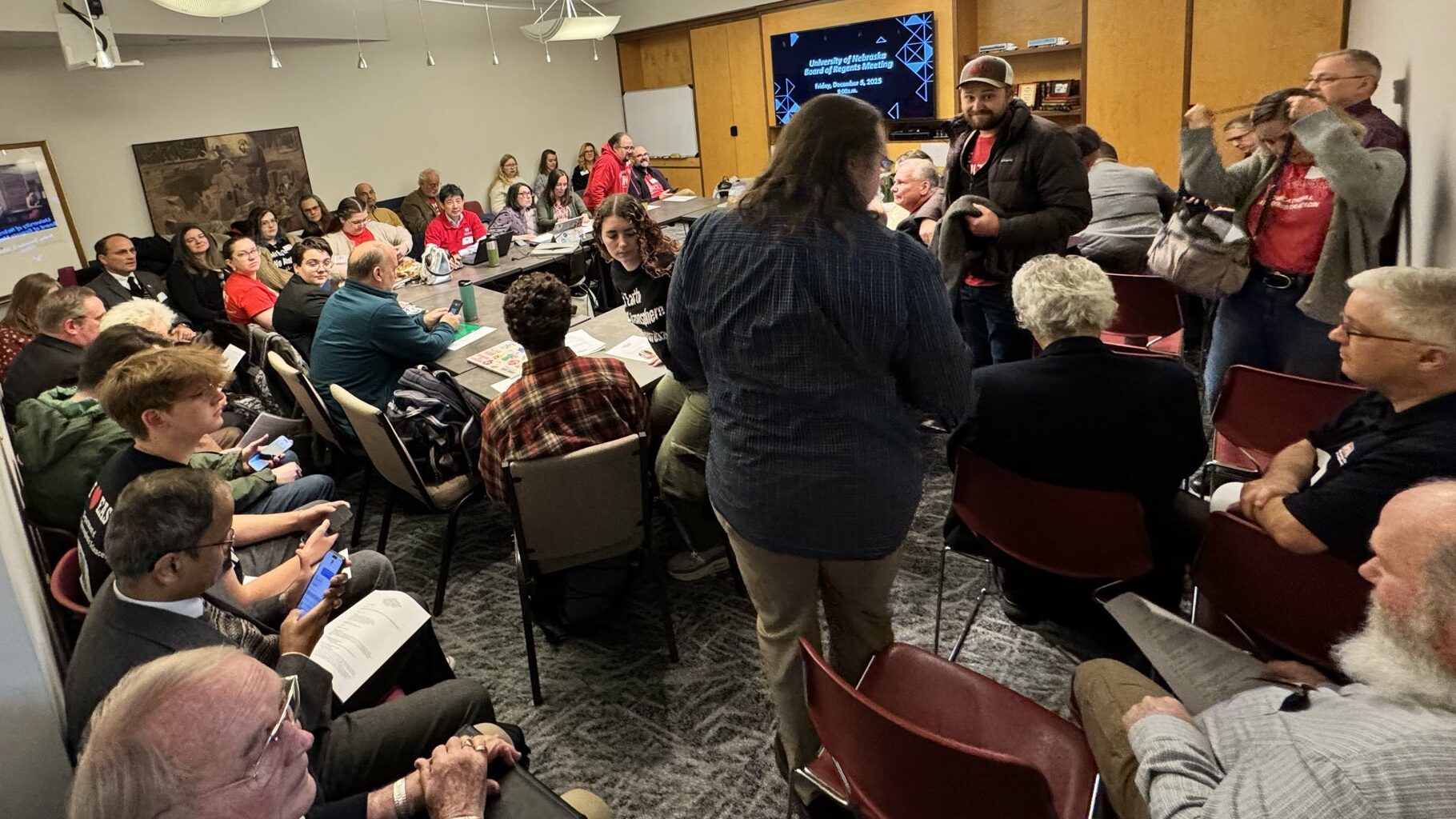
In spite of the pleas of more than 110 opponents, expressed in nearly five and a half hours of comments, the NU Board of Regents voted Dec. 5 to eliminate four UNL programs.
The regents voted separately on the proposals to eliminate the departments of educational administration, Earth and atmospheric sciences, statistics and textiles, merchandising and fashion design. The actions addressed part of the $27.5 million in reductions demanded of UNL. But most of the discussion came before the board considered any of the specific proposals.
UNL Chancellor Rodney Bennett opened the discussion, stating it would be irresponsible to ignore the structural deficit the university had been carrying for several years. Furthermore, he said, the university community had made it clear to him that “it was critically important to us to avoid implementing an across-the-board approach, which would have been detrimental to some of our most productive units and areas with growing enrollment.”
Metrics were drawn up to determine which departments could be eliminated with the least damage to the university’s mission, Bennett said. The four programs recommended for elimination, he said, all fell below expectations by those metrics. The chancellor also said, “I’ll also note that Dr. (Mark) Button (executive vice chancellor) made available an opportunity for any department who had concerns about the metrics to visit with them and to try to get that resolved.” That remark drew expressions of disapproval from people in the audience.
Bennett acknowledged the hardship the program eliminations will impose on faculty members, their families, staff and students. But he said the actions were necessary to address the structural deficit.
Some members of the Board of Regents, moved by the statements of the opponents of the cuts, asked if the vote could be delayed.
Regent Barbara Weitz of Omaha asked about the timeline used for making the cuts and the complaints of opponents that it was so rushed that opportunities for offering or considering other approaches were missed.
Bennett replied, “My recommendation is that we take immediate action. We are burning through our cash reserves at a really significant clip and the longer we delay, the problem is not going to go away.”
NU President Jeffrey Gold echoed that idea when delaying the vote by a month was suggested. “We have been burning through reserve dollars for the better part of the last decade. It just gets amplified every year, and I don’t see how much is going to change, frankly,” he said.
Paul Kenney, the chair of the Board of Regents, asked Anne Barnes, the NU chief financial officer, for her thoughts. She said any financial gains from the program eliminations would be realized over several years. “So the delay in making a decision just draws out that realization over a longer period of time,” she said. “So again, that’s the that’s the question about the burn rate.”
Brock Calamari, the student regent representing the University of Nebraska Medical Center, questioned the administration’s assumption that most of the students in the affected programs would remain at UNL by switching majors. Many of the students and faculty who spoke in opposition to the cuts said they expected the majority of students to leave for other universities.
Bennett said university leaders hoped to retain students and enroll new ones, but the majors are going to look different from the traditional ones. “We will work with the students to try to fit them into an acceptable pathway,” he said, “and we think that for the majority of our students that will be something that they are agreeing with and something that works for them.”
Weitz asked Bennett if the university was prepared administratively to do that. Bennett said the administrators were committed to helping students complete their degree programs, but they may have a more limited choice of courses to take.
The first program considered for elimination was Earth and atmospheric sciences, and Regent Robert Shafer of Beatrice said this one deserved more thought. “Of all the ones that had asked for maybe some additional time for reconsideration,” he said, “it would be this one, if I were to pick one, to say maybe we ought to give it a little further consideration and a deeper dive.” He moved to table the motion to eliminate the department. The motion failed, however.
Prior to the vote on eliminating the program, Regent Tim Clare of Lincoln said he did not want to close programs, but the financial situation required it.
“Our situation with the budget issue is not unique to higher education,” Clare said. “We heard how bad it is at the University of Nebraska. Well, let’s look around the country. Ohio State just voted last month to shut down eight majors, and they cut 260 courses. Penn State is in the process of closing seven campuses.”
Regent Jim Scheer of Norfolk said the budget problems arose from the failure of the Legislature fund the university at a rate that kept pace with inflation. He then said, “Of the 100 people here, how many of you went to the legislature when they were having a hearing on the university’s budget? My point is, the legislature is a large part of what we’re doing right now.”
Regent Kathy Wilmot of Beaver City said the cuts were regrettable, but she lauded Bennett and the UNL administrators who worked on the budget proposal. “I also want to commend Chancellor Bennett and his staff for the work that they have done to help us know what to do,” she said. “I feel like all of them through this time have maintained their professional and caring demeanor. And that has to have been hard in the face of all the accusations and the negativity that was directed to these people.”
Regents Shafer and Weitz voted against the proposal to eliminate Earth and atmospheric sciences, but the rest of the regents voted for it. (Student regents also cast voice votes, but their votes do not count officially.)
The motion to eliminate the department of educational administration passed unanimously. On the motion to eliminate statistics, Weitz voted no and Shafer abstained. Weitz also voted no on eliminating textiles, marketing and fashion design.
Two proposals for mergers—one to merge the entomology and plant pathology departments and the other to merge agricultural economics with agricultural leadership, education and communication—passed unanimously.
During the five and half hours of public comments, almost all by people opposing the cuts, the regents heard from faculty, current and former, students and prospective students. The arguments for delaying action or seeking alternatives to program eliminations tracked many of those that have been heard since the administration proposal was released:
- The recommendations were based on flawed data;
- The administration failed to consider factors such as service or prospective loss of students;
- The cuts will hurt the reputation of the University of Nebraska and undercut its chances of being readmitted to the American Association of Universities;
- The timeline for making a decision was rushed and prevented consideration of alternatives.
Most of the speakers tried to present rational arguments for why a particular program or all four programs should be retained. Elvira Abrica, interim chair of educational administration, and six colleagues used their time (each speaker was allowed three minutes) to lay out alternatives that would cut the budget but retain the four programs.
Some speakers were more emotional. Chris Bilder of the department of statistics, said he was proud to be a Nebraskan but he was no longer proud of UNL. “The reason” he said, ”is what has occurred around these budget cuts. UNL administrators want to eliminate my department, statistics, and others through a misuse of my field: statistics. They have mislabeled my department as underperforming through what they call the UNL metrics analysis.”
For Clint Rowe, the chair of the department of Earth and atmospheric sciences, the issue was tenure. The regents bylaws allow for the dismissal of tenured faculty for only three reasons: adequate cause, financial exigency, or the bona fide discontinuance of a program or department. No allegations of adequate cause, usually some misconduct, have been made, he said, nor has the university declared a financial exigency. As for eliminating a program, Rowe said the administration had singled his department out for special treatment.
“The Chancellor’s plan,” Rowe said, “includes the selective retention of several EAS faculty, and those faculty were contacted even before the plan was announced publicly and certainly prior to any decision you make today.”
This approach calls into question, Rowe said, the value of tenure at UNL. If tenure at the university is not secure, it will have difficulty attracting and retaining the best faculty members in any field. It may be particularly difficult in STEM disciplines (science, technology, engineering and mathematics) because many faculty could get higher salaries in private industry.
After the vote to eliminate the four programs, John Shrader, Faculty Senate president, issued a written statement on behalf of the Senate Executive Committee. “It is crystal clear to this committee,” he said, “that the faculty of this university is under assault, and it feels as though we don’t have support on the outside of this university or, sadly, from the inside, either.”
In other business: the Board of Regents
- Tabled consideration of housing rates for students at UNL, UNO, UNK and the Nebraska College of Technical Agriculture.
- Approved a contract between Husker Athletics and Anthony Travel; approved an amendment to a media rights agreement between Husker Athletics and Payfly; and approved resale of a fractional interest in an airplane to Silverhawk Aviation.
- Approved changes to contracts for renovations and additions to the Lied Center for the Performing Arts.
- Approved a Second Amended and Restated Declaration of Covenants, Conditions, and Restrictions for Nebraska Innovation Campus giving the NIC Development Corporation authority to approve, reject or require modification of development or construction plans.
- Approved two program statements regarding athletic programs at UNO.
