
“At the center of our agenda today is Project Health,” NU President Jeffrey Gold said in his remarks to the Board of Regents at the Oct. 3 meeting.
The board’s approval of the intermediate design plan for the massive hospital and medical training center was a major action, but the most dramatic moments of the meeting came during the public comment session.
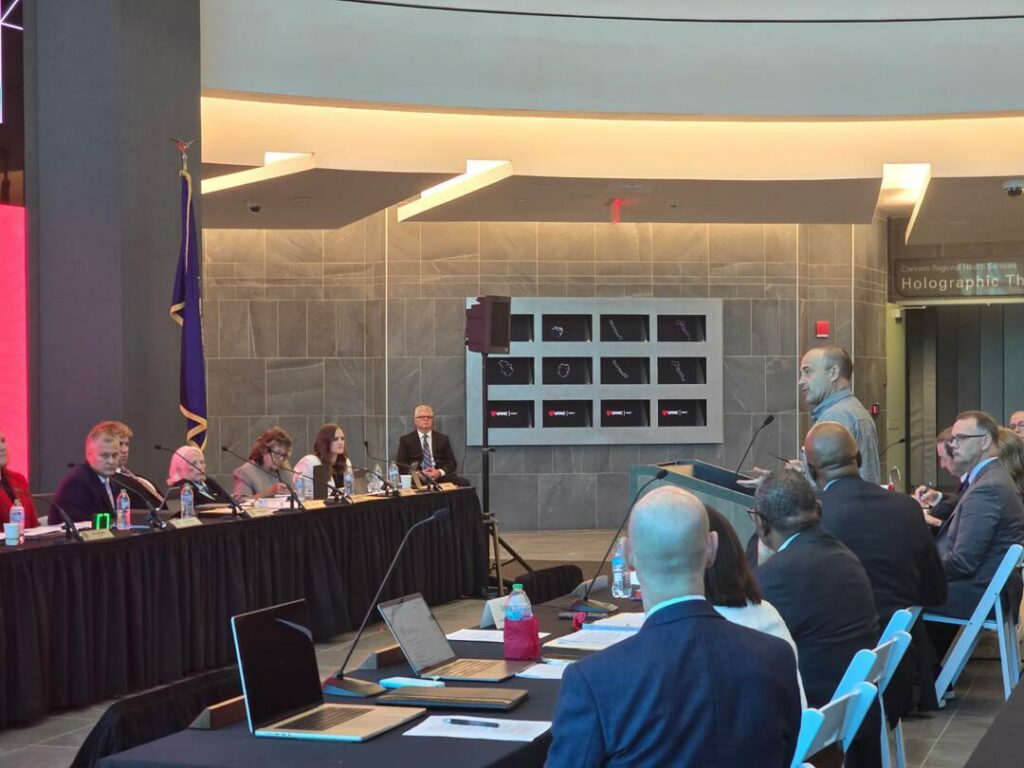
Seventeen University of Nebraska-Lincoln faculty, staff and students spoke in opposition to administration plans to eliminate six programs, merge four others and eliminate nearly 60 full-time positions, including many tenured and tenure-track professors. Three other speakers addressed the issue of Regent Elizabeth O’Connor’s position on the board in light of her being charged with a felony for causing injuries May 21 while driving while intoxicated.
The program cuts proposed by Chancellor Rodney Bennett Sept. 12 include eliminating the departments of education administration, earth and atmospheric sciences, statistics, community and regional planning, landscape architecture, and textiles, merchandising and fashion design. It would also merge the department of entomology with that of plant pathology and merge the department of agricultural economics with that of agricultural leadership, education and communication. Two colleges, Engineering and Arts and Sciences, would have their budgets cut. Those program eliminations, mergers and budget cuts would account for more than $10 million of the $27.5 million UNL needs to cut. The remainder—about $17.2 million—would come from a variety of administrative cuts.
The UNL contingent criticized the administration for abandoning shared governance, using faulty data for evaluating programs, failing to explain the criteria used to select the programs for elimination, harming students and staff, and neglecting the university’s core values. The speakers asked the regents to delay the cuts until a more careful review can be completed.
Sarah Zuckerman, an associate professor in education administration and president of the UNL AAUP chapter, said the university’s administrators failed to engage the faculty in the budget-cutting process. Shared governance, in which administrators and faculty collaborate, helps assure good decisions, she said.
But with these reductions, the administration was ignoring its own procedures for involving the faculty, a mistake the university made in 2018 when it dismissed a graduate student from her teaching assignment, Zuckerman said. That action drew censure from the AAUP, which took years to remove.
Several faculty members said the administration’s recommended cuts are based on faulty or outdated information or taking data out of context.
Kent Eskridge, a professor of statistics who has been on the UNL faculty for 38 years, said he and his colleagues have been trying to reproduce the calculations used by the administration, but they have been stymied by the refusal of administrators to release much of the data they used.
Eskridge said what they have discovered is that the administration has systematically overcounted the number of faculty in departments and undercounted many of the performance measures used in evaluating faculty.
Two other members of the statistics department faculty, professor Heike Hofmann and associate professor Susan VanderPlas, echoed Eskridge’s complaints. Hofmann said many of the metrics used in preparing the budget recommendations are used for intercollegiate comparisons. They may be appropriate, she said, for comparing the UNL statistics department with a similar one in a different university, but they are not appropriate for comparing the UNL statistics department to the UNL music department.
Jennifer Johnson Jorgenson, associate professor and chair of the textiles, merchandising and fashion design department, said the administration largely ignored the creative scholarship undertaken by faculty in her department. That creative work is one of the factors used in evaluating individual faculty, she said. The faculty’s extension work was also ignored, she said, even though the department’s extension specialists reach every county in Nebraska. The metrics used to evaluate the department, she said, should be revised to include creative and extension work.
Several faculty members said the proposed program cuts will harm students and the state. Sandra Starkey, an associate professor in textiles, merchandising and fashion design, said the fashion and retailing industry in Nebraska is growing and employs a large number of her department’s graduates. Jorgenson also noted the demand for employees with the type of training her department provides. More than 35,000 jobs in Nebraska rely on the apparel industry in some way, she said, and closure of the TMFD department will deny students opportunities to work in a growing field.
Robert Szot, a graduate student in the department of earth and atmospheric sciences, said he came to Nebraska from Texas to pursue an advanced degree because of the kind of research being done at UNL. The department’s researchers fly planes and drive vehicles into storms to collect data that makes forecasts more accurate, he said. It’s the kind of research on which farmers and others rely. Closure of the department, he said, will force him to pursue his degree elsewhere and deprive Nebraskans of weather information they’ve come to trust.
Elvira Abrica, the acting chair of the education administration department said her program’s alumni serve in every educational unit in Nebraska. The department provides value to schools throughout the state, she said, in ways that help ensure the quality of education at all levels. Crystal Garcia, associate professor in education administration, said eliminating the department will deprive students of an in-state opportunity to prepare for administration positions and deprive school districts of a reliable source for trained administrators.
Barney McCoy, a professor broadcasting, noted that former President Ted Carter had proposed a plan, approved by the regents, two years ago to eliminate the structural deficit, put NU on the path to regaining membership in the American Association of Universities and make it a national player. The new round of program cuts will destroy that plan. “We’re not back on track. We’re not becoming a national player,” McCoy said. Students will suffer by having to pay higher tuition to take larger classes with less choice of classes to take, he said.
For other speakers, the reductions proposed by the administration represent an abandonment of some of higher education’s fundamental values.
Elizabeth Niehaus, a professor in education administration, said the program decisions the administrators are recommending suggest they value grants over producing teachers and administrators, value membership in the AAU over directly serving the people of Nebraska, and value tuition revenue over high-quality student learning.
“Our mission is not to become part of an academic country club,” Niehaus said. “Our mission is to educate students, to produce knowledge that changes people’s lives and extend that knowledge throughout the state.”
Chancellor Bennett and other UNL administrators have said the reductions they are recommending represent difficult decisions. Erin Haacker, associate professor in earth and atmospheric sciences, said, “I never again want to hear from higher administration officials what difficult decisions they are making when they have no skin in the game.” The real difficult decisions, she said, are being made by the faculty, staff and students who will lose their jobs or have to study at a different school.
Of the three people who spoke about Regent O’Connor, two urged her to resign from the board. One of those two was Ricoh Mountain. His three young daughters were riding in the back seat of the Ford Focus that was struck by O’Connor’s Subaru Outback May 21 along with their grandmother, Mountain’s mother-in-law. All were injured. Mountain said his mother-in-law suffered a broken back and pelvis and remains in the hospital.
Mountain said O’Connor should resign from the board or the regents should remove her as a member.
Carolyn Folsom of Omaha approached the lectern and, looking directly at O’Connor, said, “I think you should be ashamed of yourself.” She said O’Connor should resign.
Both Mountain and Folsom said if either of them had been involved in a serious accident driving while intoxicated, they would be in jail.
Joseph Neary of Omaha, however, said he supported O’Connor and she should remain on the Board of Regents, at least until her case has been decided in court. He said it was unfair to call for her removal from the board before due process has run its course.
Although the accident occurred May 21, O’Connor was not charged until early August. She is accused of causing serious bodily injury while driving under the influence of an intoxicant, a Class IIIA felony with a maximum penalty of three years in prison, 18 months post-release supervision and a $10,000 fine.
The Douglas County Attorney’s Office said the delay in charging O’Connor was because the office was waiting for the results of laboratory tests on her blood. After she was charged with the crime, O’Connor was released on $25,000 bail. She is required to participate in the Douglas County sobriety program and submit to daily drug testing.
In other business, the Board of Regents:
- Approved the intermediate design review for Project Health. The approval allows the university to start spending about $1.2 billion for the construction project. When completed, it will be the primary in-patient hospital for Nebraska Medicine and a facility for accelerating the training of medical professionals to serve the state. The total project is expected to cost $2.19 billion.
- Eliminated the master of science in horticulture at UNL. The program’s enrollment has failed to meet the requirements set by the Coordinating Commission for Postsecondary Education. In its place, the master of science in agronomy will be renamed the master of science in agronomy and horticulture. The changes will have no impact on faculty or staff.
- Eliminated the bachelor of science in industrial technology and the bachelor of science in applied science comprehensive at the University of Nebraska Kearney. The university will continue to offer an industrial distribution degree with minors in industrial technology and industrial technology applied science comprehensive.
- Approved a change to the Bylaws of the Board of Regents providing that the chair of the board shall serve for two years. The purpose is to provide more continuity in leadership. The change also removes the requirement that the vice chair automatically become the next chair. Other bylaw changes affected procedures in business and finance.
