
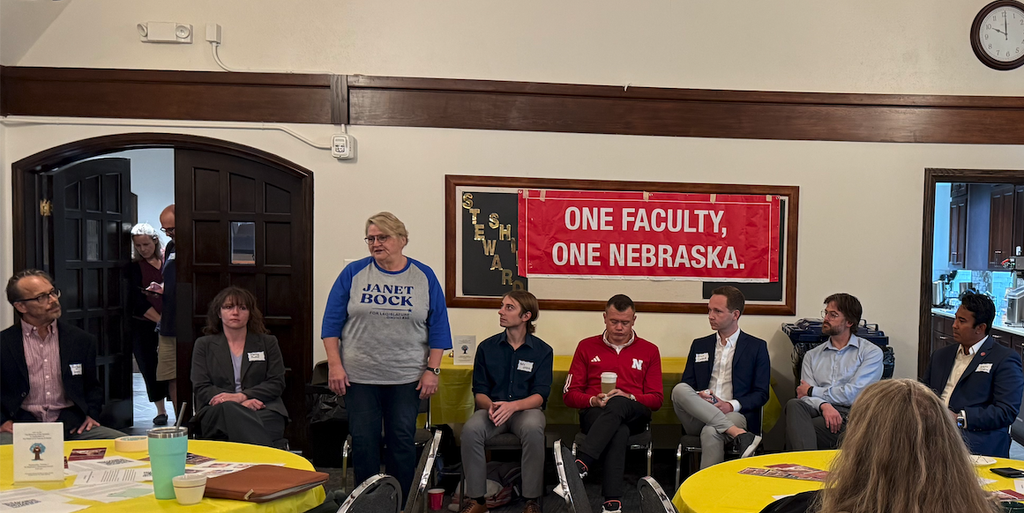
The Academic Freedom Coalition of Nebraska (AFCON) and AAUP Nebraska held a forum for candidates for state and federal office on Saturday morning, September 19. What follows is a description of their introductions and answers to audience questions. (Some answers have been omitted for the sake of length.)
Introductions
Rick Beard, the Legalize Marijuana Now Party’s candidate for governor, is dissatisfied with he mismanagement of state funds, particularly the granting of perks to corporations that are not upholding obligations to create jobs. He objects to the state blocking cannabis legalization. He hopes that his candidacy will get ideas for eliminating corporate money in politics and returning power to the people to circulate. Several times during the meeting he pointed to Montana’s Ballot Initiative I-94 as a model that Nebraska can follow.
Macey Budke, running for the U.S. House of Representatives in Congressional District 3 for the Nebraska Working People Party, has a child with autism, and emphasized her interest in accessibility for the disabled in education. She spoke about the dramatic improvement in her family’s prospects that came when her mother earned her RN when Budke was a child.
Janet Bock, a psychiatric nurse who also has a child with special needs, was a member of the Tri-County School Board for twelve years. She is an advocate for public schools and continuing education. She is herself a lifelong learner, having earned her master’s degree from UNMC in 2005.
Nate Ostdiek, who is currently pursuing a graduate degree at UNO, said he is an “unapologetic advocate for higher education,” and also expressed concern with the state government’s pursuit of corporate interests at the expense of ordinary people. The AI data center buildout concerns him because ordinary people are getting the short end of the stick.
Justin Solomon, running for Regent in District 4 in Omaha, is a “proud product of public schools” who attended UNL on a Pell Grant and Regents Scholarship. He compared higher education to Medicaid in that they are both asked to continuously do more with less.
Brent Comstock, candidate for Regent in District 1, is the child of a public school special ed teacher, and said his emphasis is on affordability. He said that Board of Regents’ job is not to be managerial toward the university, and it needs to focus on its duty to uphold academic freedom and ensure a stable budget.
George Dungan is currently serving as state senator for District 26 in Lincoln. He sees higher education as the key to Nebraska attracting and retaining people. He said the university has suffered under systematic cuts by the state legislature, and he said that the executive branch, in particular, has been unwilling to adequately fund the university despite saying otherwise. He ihas consistently fought cuts to the university in his time at the legislature.
Jeremy Hosein, a neurosurgeon and former student regent who is running for Regent in District 4 against Comstock, said that the university has been faced with uncertainty year after year. He said he that he knows we are at the point where professors are emptying their own trash. While there have been massive construction projects for NU, “buildings don’t teach, people do.”
Opinion of NU President Gold
The floor was then opened up to questions. Sean Trundle (History, UNL) began, asking what the candidates for regent thought of Jeffrey Gold’s leadership and whether they would support his reappointment if they were in office today. All three regent candidates balked at criticizing Gold. Solomon and Hosein said that the Board’s job is to provide political cover for Gold when he makes tough decisions, and that the Board has failed to do this. Comstock seemed to agree, describing Gold as working in a “politically toxic” environment. Nonetheless, Comstock thinks it’s unacceptable for admin to be collecting bonuses when faculty salaries are frozen. Solomon and Comstock each pointed to the problem of turnover at the highest levels of the administration, noting that Gold seems committed to staying. Comstock added that the emphasis needs to be on finding a permanent appointment for chancellor at UNL, who would be able to transform the culture on campus after years of demoralization.
What is the Regents’ Job?
Kay Siebler (English, UNO) recounted that at the December Board of Regents meeting, Regent Scheer “had the audacity” to chastise faculty for failing to lobby for the university at the legislature. That’s the job of the Board of Regents, she pointed out, and asked the candidates what they see as the roles of the Board and other representatives in this. Solomon said he is actually running for Regent because of what Scheer said—that moment made it clear to him that they need people who are not faculty advocating at the highest levels for the university. He said we are “in war time at the state and federal level” because of the threats to higher education. Comstock said that the governor currently wants another 5% cut from the university, and if experience is a judge, we will wait until appropriations are done and then say we should have handled it differently. He thinks the Board is failing to protect the university financially and that they are not even reaching out adequately to the donor community. Hosein thinks some of the Regents are still under the impression that being a regent is an honorary position, and that we need a new generation of leaders who will actively call on the right people. As far as faculty advocating at the legislature goes, Ostdiek said that during his time as a student activist who advocated to the legislature and Board of Regents, students actually had their future careers threatened for their advocacy. Dungan, who serves on the Legislature’s Revenue Committee, said not one of the Regents has ever reached out to discuss the budget with him.
On Keeping University Leadership Candidates Secret
John Bender (Emeritus, Journalism, UNL) reminded the candidates that some years ago the legislature changed the appointment process so that candidates for the highest administrative positions are kept secret until one finalist is announced. He asked if the candidates believe that to be a necessary or effective policy change. The candidates unanimously found that change unacceptable and counter to the democratic principle of transparency.
The Purpose of Public Education
Regina Werum (Sociology, UNL) asked the candidates what they see as the purpose of public education. Hosein replied that the university should be judged by how many graduates we are creating who can be gainfully employed, who we connect to employment, and who we “make AI capable.”
Werum, resisting employment and AI readiness as barometers of public education, replied, “I teach the whole person.”
Dungan said that the ways many people quantify the value of education is problematic. We are not just teaching to create income. The GDP doesn’t capture art, family, the quality of life factors that make people want to live in a place. Every program at the university has value.
Comstock said that we need to focus on retaining young people, and we also need to retain our faculty and staff. He sees privatization as a constant erosion of public schools. Solomon added that public schools, including both K-12 and higher education, suffer from mission creep, because as a place that reaches such large numbers of the public, they are constantly being asked to supply more and more to people.
Empowering a Demoralized Faculty Body
Beth Lewis (TLTE, UNL) listed several related concerns at UNL: many professors are doing the work of two faculty members; we have a non-unionized campus with no cost-of-living adjustments; there is brain drain from the university; leadership egregiously uses the university as a stepping stone to other jobs; the state government wants to intrude on our academic freedom. She asked: would you fight for the presidents of the different campuses’ faculty senates to have a vote on the Board?
Solomon and Comstock replied that it would defy the state constitution to give them a literal vote, but that the principle of shared governance needs to be reinforced.
AI and Enshittification
I, Amanda Gailey (English, UNL), said that the problems people have identified with the university are an example of what Cory Doctrow calls “enshittification,” where corporations and a corporate class are extracting whatever value for themselves that they can from the university with no regard to what it does to the mission of the institution. The best example of this is partnering with AI companies and shoving AI at everyone. It may be the case that there are places for AI in the curriculum in some disciplines, but given that AI is used largely to avoid reading, writing, and doing the work, the default assumption should be that AI is damaging to student minds and learning. What do the candidates think? Who should be making decisions about AI in the curriculum?
Hosein replied that we need to put people before AI, and that we need people with ethical understandings of AI. He pointed to the use of AI in medicine and the need for people in that field to use medical AI. (I appreciated his response, but in other forums he has been less circumspect about AI. Part of his platform is to “integrate AI literacy…across every discipline,” which would intrude on academic freedom even if it didn’t harm students and many disciplines, which it does. He has also suggested that AI could be used to fill staff vacancies.)
Solomon said that both enshittification—which he calls “the higher ed industrial complex”—and AI are changing education, and faculty need to be the ones determining how AI is used. The Board needs to listen to educators.
Comstock said that people power institutions, and that the Board needs to recognize that faculty are the experts.
Beard replied that AI is a powerful lobby and this is another reason we need to get dark money out of Nebraska politics.
Ostdiek said that he is “radically in favor of empowering faculty,” that he is disgusted by the way the administration is pushing AI, and that in his grad courses he has seen how it is effecting education.
Championing the Arts and Humanities
Katie Anania (Art History, UNL) said that in times of budget crisis, there is a rush to support programs that people see as engines of prosperity, while other programs, including core programs, are treated as expendable. What will the candidates do to center and protect the arts and humanities?
The candidates commented on how much they love the arts and humanities. Solomon said AI makes it clear that it’s time to double down on the arts and humanities. Anania replied that she was asking specifically how they will center these programs in the face of opposition.
Macey Budke pointed out that in public schools it seems like even when they are short on books and don’t have money for the theater program, they can always find the funds for new astroturf on the football field.
Hosein pointed to the two hermetically sealed funding systems: the ever-sprawling athletic pool and the academic one. Why are these separated? He pointed to Vanderbilt as an example of a university that gives athletic perks to people who donate to academics.
Time ran out before anyone could ask a follow up: should the arts and humanities be dependent on private donations (especially given how private donations have a nasty way of encroaching on academic freedom and shared governance)? Or should the state properly fund these programs, core to human flourishing, at a university whose seal claims LITERIS DEDICATA ET OMNIBUS ARTIBUS—Dedicated to letters [literature] and all the arts?
